


Sioh Yang Tan
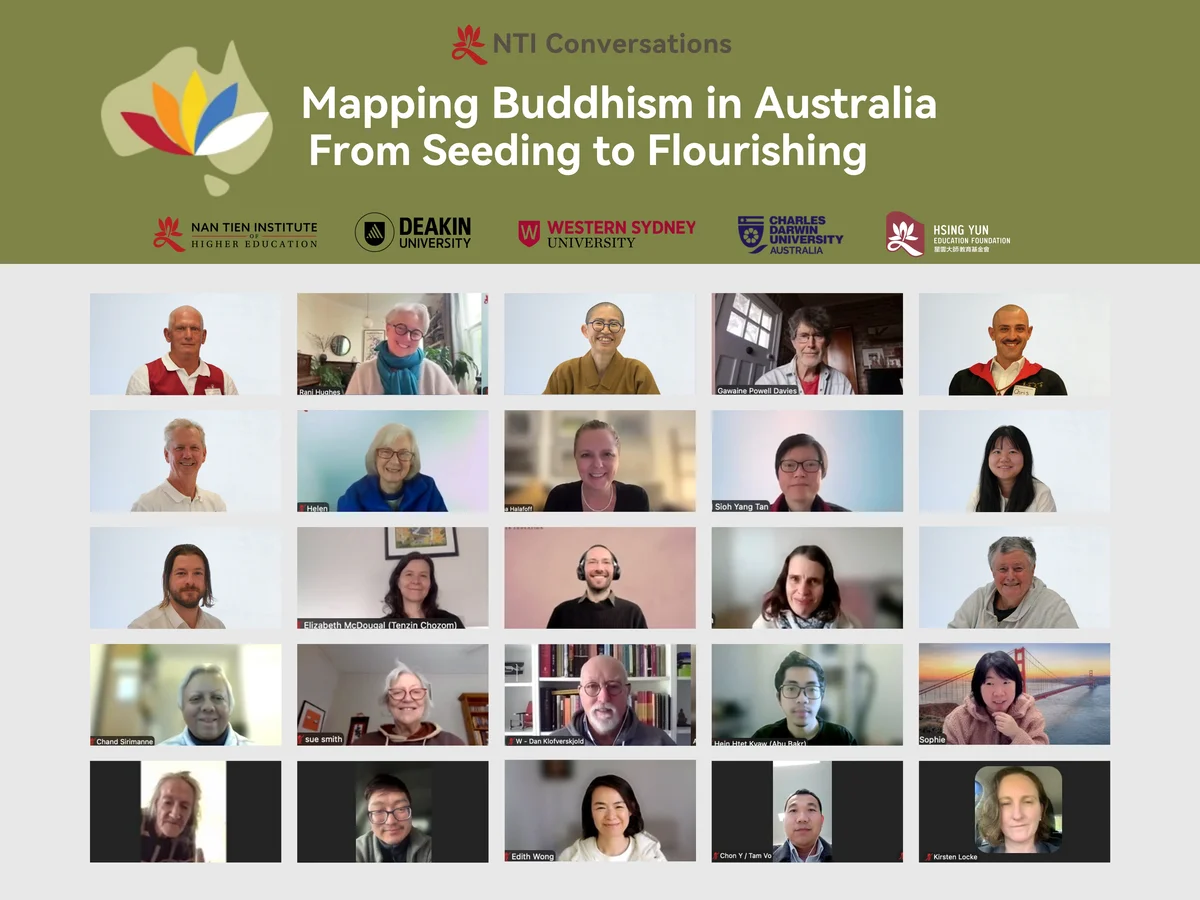
The NTI Conversations seminar, “Mapping Buddhism in Australia: From Seeding to Flourishing,” on 12 August 2026 brought together 40 participants in person and online to explore the historical development and contemporary diversity of Buddhism in Australia. The seminar was presented by Professor Anna Halafoff and hosted by Associate Professor Venerable Juewei, Director of the Humanistic Buddhism Centre at Nan Tien Institute.
The presentation formed part of the three-year research project Buddhism in Australia: Belonging, Wellbeing and Social Engagement, led by researchers from Nan Tien Institute, Deakin University, Western Sydney University and Charles Darwin University, with support from the Hsing Yun Education Foundation.
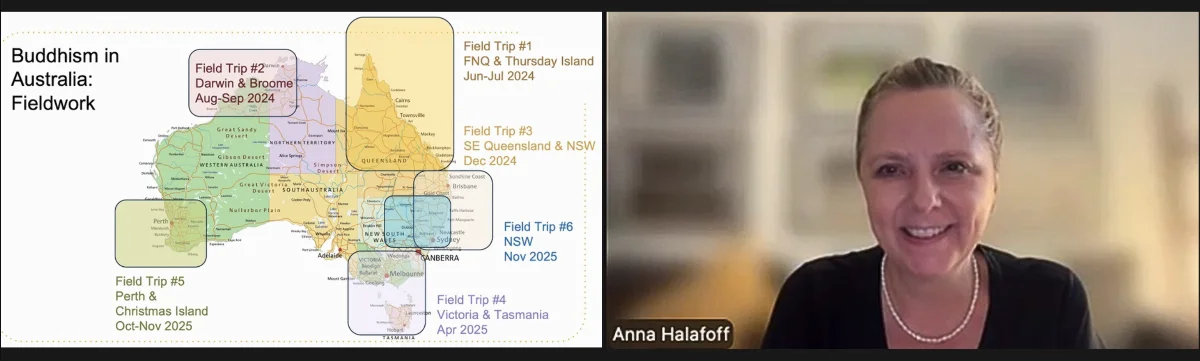
Anna Halafoff, a Chief Investigator on the project, explained that this nationwide project is the first of its kind and scale to document the presence of Buddhism in Australia, tracing a journey from the early “seeding” of Buddhist ideas, practices and communities to the flourishing diversity visible across the country today. The project has both historical and contemporary focuses, using mixed methodologies including fieldwork, interviews, video and photographic documentation of religious materiality, archival research and a national survey.
While building on previous scholarly work, the project is unique in its emphasis on the northern parts of the continent and in centring Asian voices, communities and contributions to Australia. Adopting a decolonial lens, the project is broadly divided into three periods from the 19th century to the present, reflecting policy changes that affected the Buddhist and Asian communities it studies.
Halafoff also shared her personal journey into Buddhism and research, recounting how she was inspired by earlier scholarly work by Paul Croucher to search for the first Bodhi tree planted by Sri Lankan Buddhists on Thursday Island. One of the surprising findings of the project was the close relationships between Indigenous and Asian communities in the Far North, such as on Thursday Island and in Broome and Darwin.
She also highlighted Christmas Island, which has the highest concentration of Buddhists in Australia. The island has unique natural and cultural heritage, with Buddhist and Taoist temples spread across the island, some dating back to 1903. Many continue to be cared for and used as places of worship and community today.
In response to questions from the floor, Halafoff pointed to several notable and arguably distinctive characteristics of Buddhism in Australia. These include the presence of umbrella organisations such as the Federation of Australian Buddhist Councils, the Australian Sangha Association and state Buddhist councils; evidence of mutual support and solidarity across lineages and traditions, and between Asian and Western Buddhists; and strong respect for monastics, with less division between monastic and lay Buddhists. She suggested that these characteristics may partly reflect Australia’s geographic proximity to Asia and its longstanding history of interactions with the region.
Findings from the project will be presented and published as academic papers, a monograph, a project report and educational resources in the Digital Atlas of Buddhism in Australia. Associate Professor Venerable Juewei, Project Leader of Buddhism in Australia, thanked Halafoff for her presentation and invited the audience to attend the project launch on 22 September 2026, when the Digital Atlas will be shared publicly for the first time.
評論(0)
目前沒有評論,歡迎分享您的看法。
登入會員後即可發表評論、回覆及讚。