


Fo Guang Shan Nan Tien Temple
A recent online survey found that Buddhists in Australia have high agreement on basic Buddhist doctrines. However, their Buddhist practices are diverse and include meditation, chanting, reading scriptures and other Buddhist texts, and more. While the majority of Buddhists are born overseas, most have a strong sense of belonging in Australia.
These were some of the findings from the Buddhism in Australia Survey, an online questionnaire administered from September 2025 to June 2026 in seven community languages to survey adults residing in Australia who are Buddhists or who adopt Buddhist ideas and values. The survey was part of a collaborative multidisciplinary research project themed “Buddhism in Asutralia: Belonging, Wellbeing and Social Engagement”, spearheaded by Nan Tien Institute, Deakin University, Western Sydney University and Charles Darwin University with support from Hsing Yun Education Foundation.
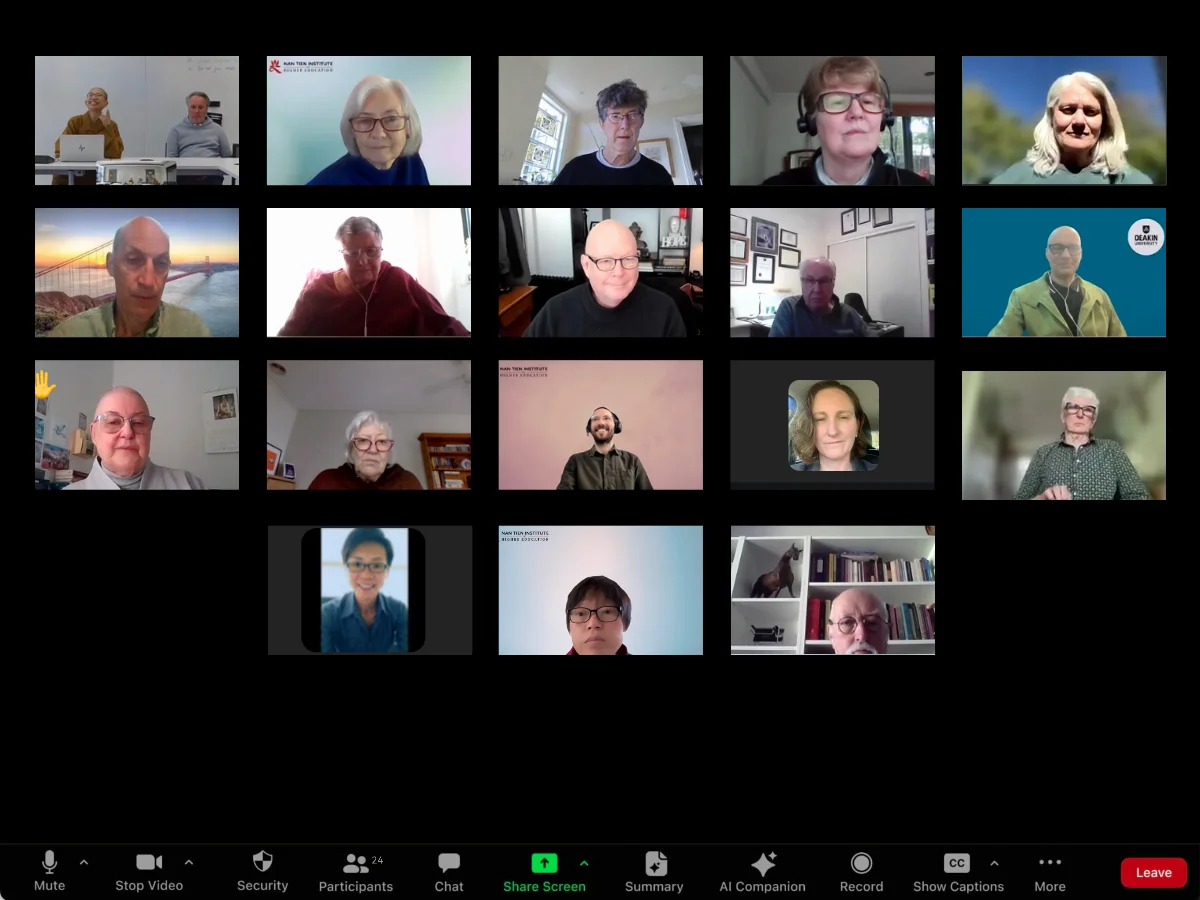
Professor Andrew Singleton, a Chief Investigator of the Buddhism in Australia research team, unveiled preliminary findings from this first nationwide study examining the experiences of Buddhists in Australia in a seminar on 29 July 2026, as part of the “NTI Conversations” series, hosted by Venerable Assoc Prof Juewei, Director of Humanistic Buddhism Centre at Nan Tien Institute. The hybrid event attracted close to 40 participants, including scholars, Buddhist leaders, monastics and community representatives from across Australia and overseas.
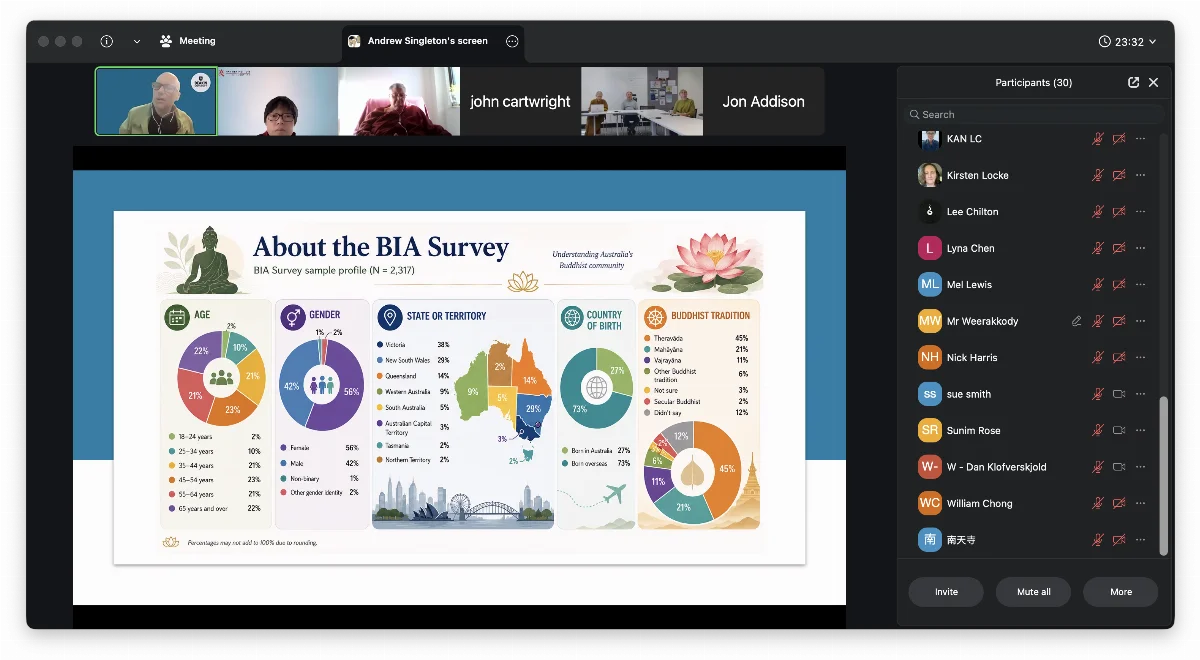
The survey respondents were recruited through Buddhist temples, organisations, Buddhist events and on social media. According to Singleton, the survey was completed by 2,317 respondents, equivalent to a completion rate of approximately 66%. The high number of responses, completion rate, and the diverse traditions represented in the survey assured the research team of the robustness of the survey.
73% were born overseas, revealing a strong association of Buddhism with migration in Australia. Among them there was strong association bwtween country of origin and Buddhist tradition. For instance, those who were born in Sri Lanka are by vast majority Theravadin, while those born in East Asia and part of Southeast Asia follow the Mahayana tradition. On the contrary, those born in Australia are more varied and comprise those in Theravada, Mahayana, Vajrayana or other traditions.
The survey questions examine what do the respondents believe in, how do they practice and participate in Buddhist activities. The survey found that three-quarters of respondents relate to Buddhism as a guiding philosophy or worldview. Around two-thirds also see it as a source
of purpose and meaning in life and as their religion or faith. This shows that for most respondents, Buddhism is more than a cultural identity.
Coming from a religious studies background, Singleton found the high agreement of respondents on basic Buddhist doctrines striking. The respondents strongly agree on core Buddhist doctrines, as well as ethical and practical Buddhist teachings, while showing relatively lower beliefs on metaphysical concepts.
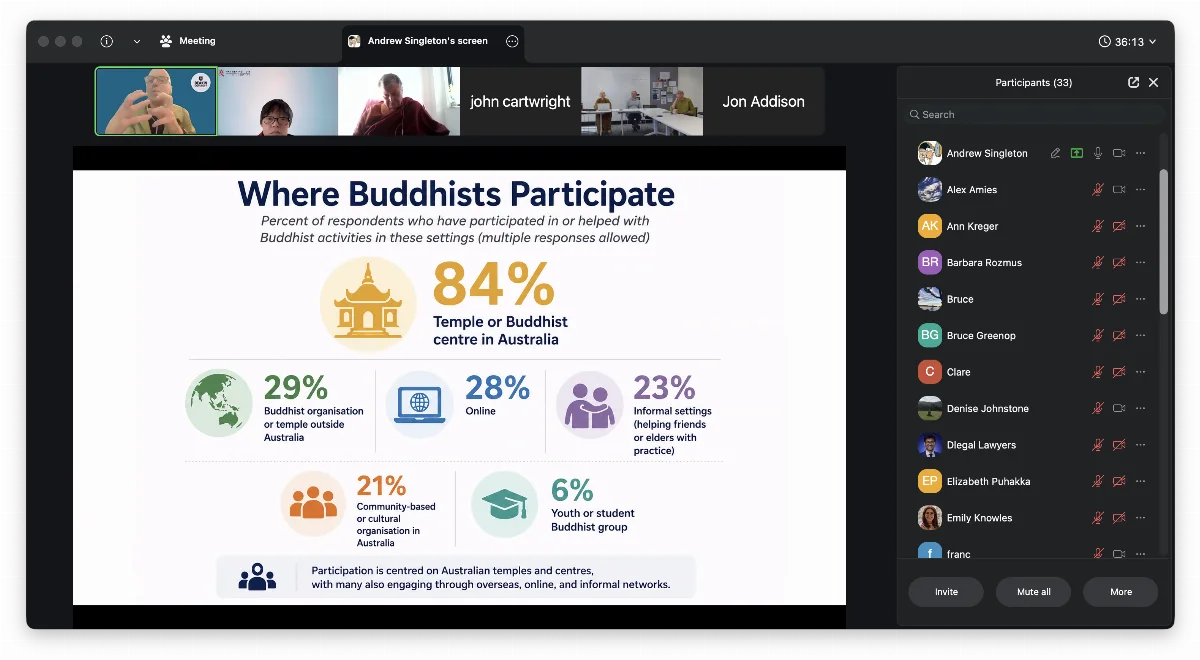
In contrast to the high agreement on beliefs, Buddhists vary in their individual practices. Meditation, chanting sutra, reading scriptures, reading texts by contemporary Buddhist teachers were just some of the ways Buddhists practise. While these practices may occur privately at home or in communal settings, 87% of the respondents reported participating in a Buddhist temple, centre, organisation or community in the past year. While participation is centred on temples and centres in Australia, many also engaging through overseas, online, and informal networks, demonstrating that the mode of participation of Buddhists in Australia is flexible, transnational and digital. Buddhists from the different Buddhist traditions strongly concur on core Buddhist beliefs, but show diversity in how they practice and participate in their communities.
Venerable BomHyon sunim, chairperson of the Australian Sangha Association, congratulated the research team on the excellent work and expressed interest in sharing the presentation with the sangha community. She hoped there will be follow up studies to look at how young people engage with Buddhism, noting that their Buddhist identity and participation could be fluid and diverse. Dinesh Weerakkobody, president of the Buddhist Council of Victoria, expressed interest in the Project Report, which will contain more details about the survey and be launched at Nan Tien Institute on 22 September. Gawaine Powell Davies, Director at the Buddhist Council of New South Wales, asked if the survey detected any patterns on how Buddhism and Buddhists have adapted to the Australian society. Andrew Singleton pointed out that survey data showed more diversity in adherence to particular Buddhist traditions, as well as intergenerational difference in the data, which will be detailed in the project report and an academic paper later.
In closing, Venerable Juewei thanked the audience for their expression of interest, and invited them to join the next NTI Conversation on 12 August, when Prof Anna Halafoff will speak about fieldwork findings of the project in “Mapping Buddhism in Australia: From Seeding to Flourishing”.
The video recording of this Conversaiotn is available on the NTI Conversations webpage: https://www.nantien.edu.au/events/nti-conversations/
--
On 29 July at the NTI Conversations held by Nan Tien Institute, Professor Andrew Singleton, Chief Investigator of the Buddhism in Australia research team, unveiled preliminary findings from the first nationwide study examining the experiences of Buddhists in Australia in his talk "Buddhism in Australia Survey: A First Look at the Findings". The hybrid event attracted close to 40 participants, including scholars, Buddhist leaders, monastics and community representatives from across Australia and overseas.
Part of the collaborative Buddhism in Australia research project spearheaded by Nan Tien Institute, Deakin University, Western Sydney University and Charles Darwin University with support from Hsing Yun Education Foundation, the survey was conducted between September 2025 and June 2026 and completed by 2317 people. The online survey was disseminated through social media, posters, flyers and emails to Buddhist organisations and communities in seven languages to increase accessibility and uptake. (?)
Identify, eligibility
THe BIA survey was benchmarked against the data on those who
According to Andrew Singleton, the significant number of respondents, a high completion rate, and the breadth and diversity in the demography of the survey gave him confidence of the robustness (and ..)
Andrew first presented the profile of the respondents,
Drawing on responses from Buddhists representing diverse traditions and cultural backgrounds, the survey explores themes including religious practice, Buddhist values, wellbeing, belonging, volunteerism, social engagement and the contribution of Buddhism to Australian society. The research also examines how Buddhist communities engage with broader social issues and contribute to intercultural understanding and community wellbeing.
Following the presentation, participants engaged in lively discussion on the implications of the findings for Buddhist organisations, policymakers and researchers. Buddhist leaders shared their reflections on emerging trends within Australia's Buddhist communities and discussed how the research can support future planning, education and community development.
Buddhism in Australia: Wellbeing, Belonging and Social Engagement. The project, led by Nan Tien Institute in collaboration with Deakin University, Western Sydney University and Charles Darwin University, seeks to provide the most comprehensive picture to date of Buddhism in contemporary Australia.
As the project continues, the research team will further analyse the survey data alongside oral histories, fieldwork and historical research to build a richer understanding of the diverse experiences of Buddhists across Australia.
評論(0)
目前沒有評論,歡迎分享您的看法。
登入會員後即可發表評論、回覆及讚。