


By Xin Ying, Sendai, Japan
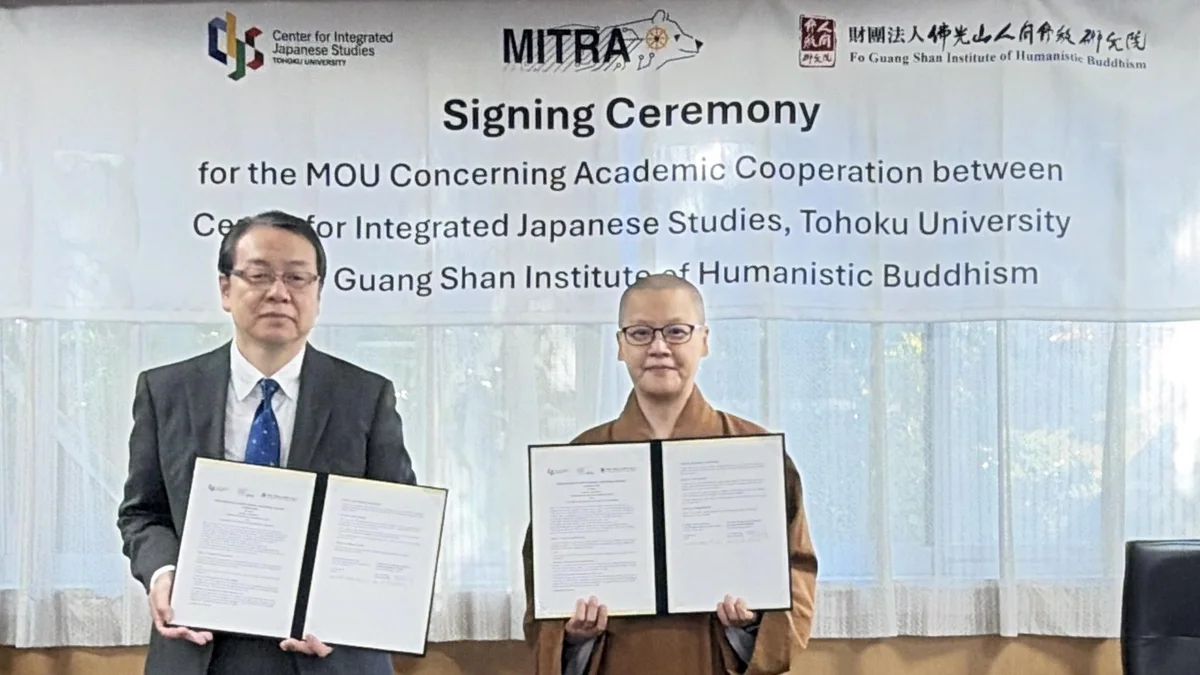
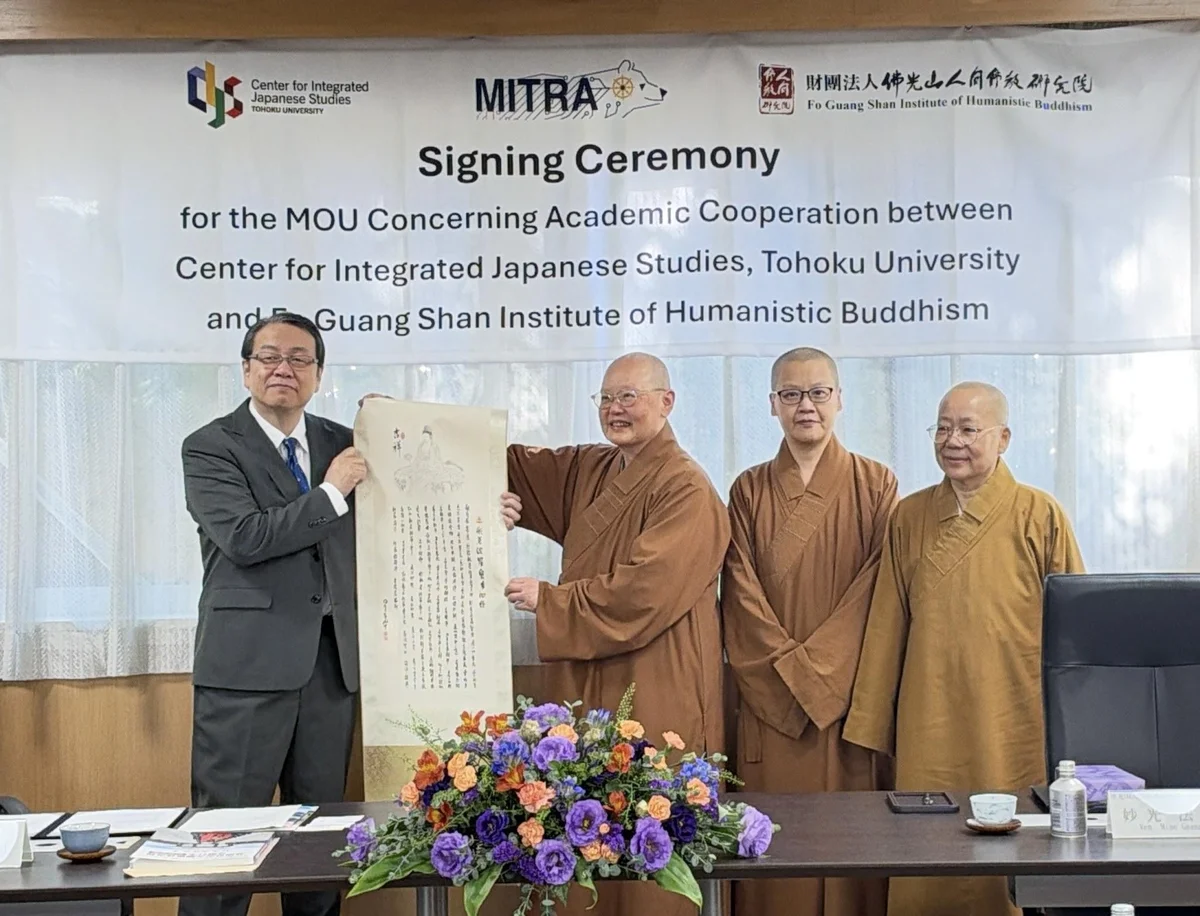
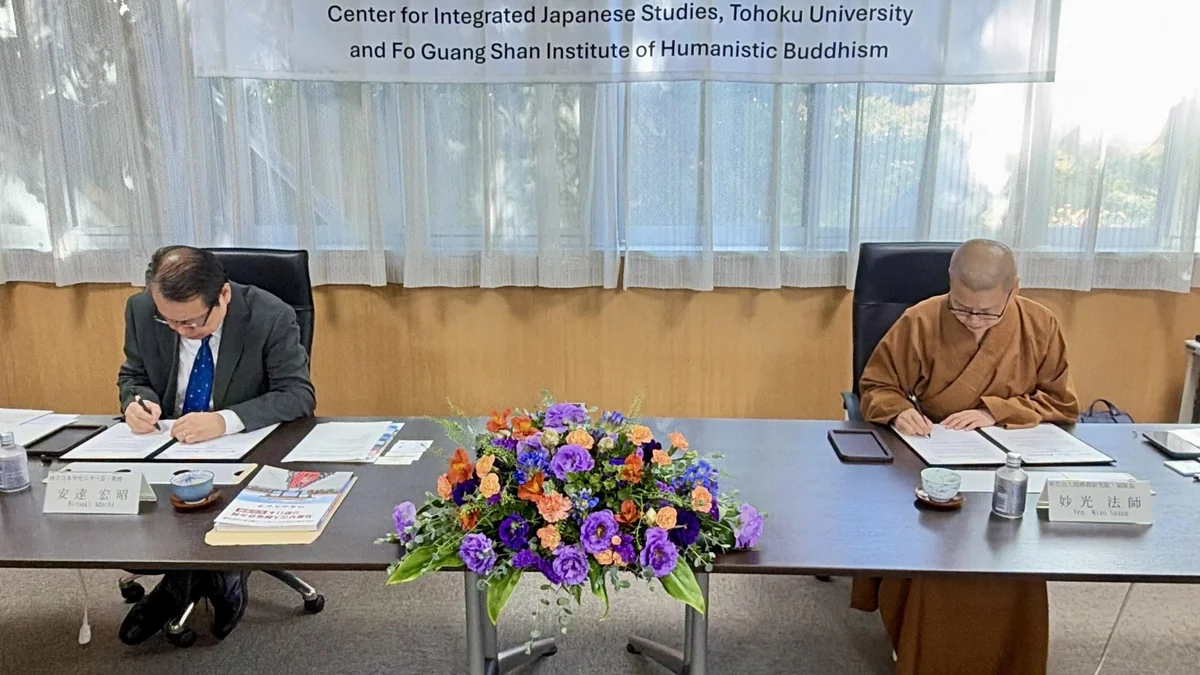
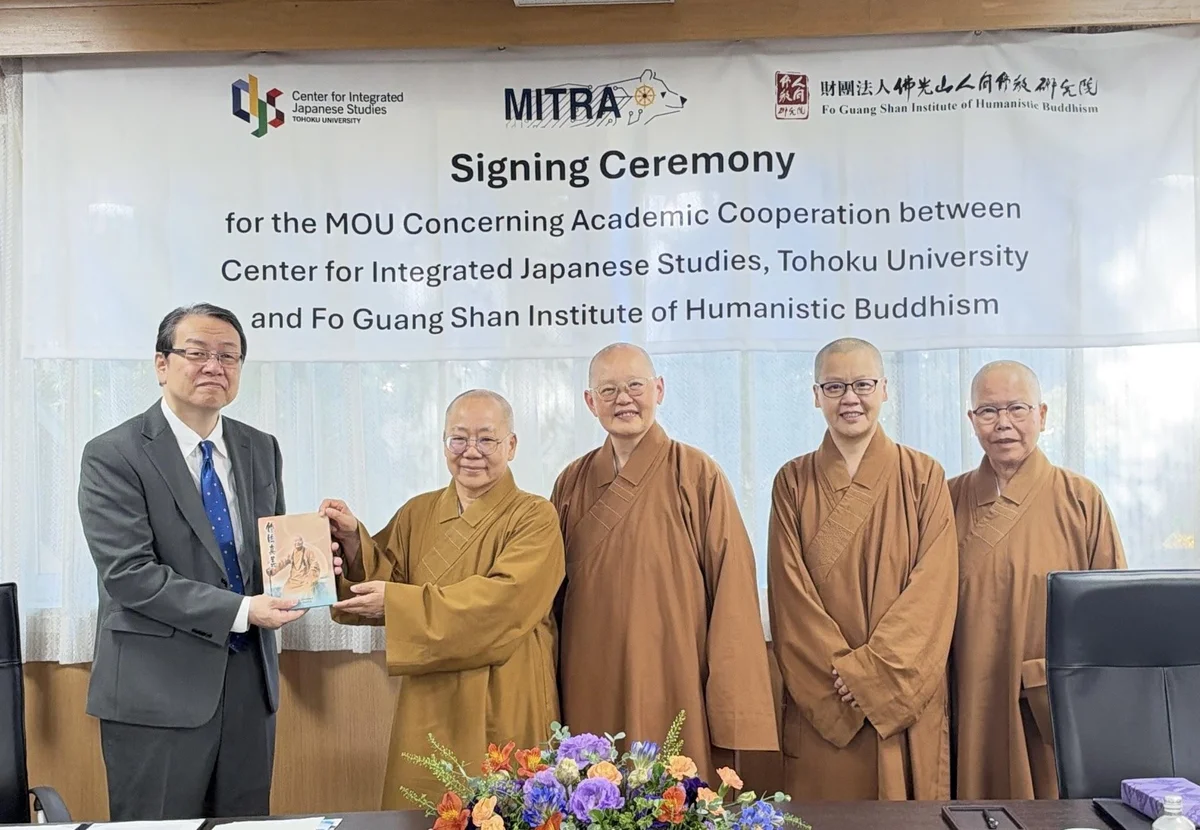
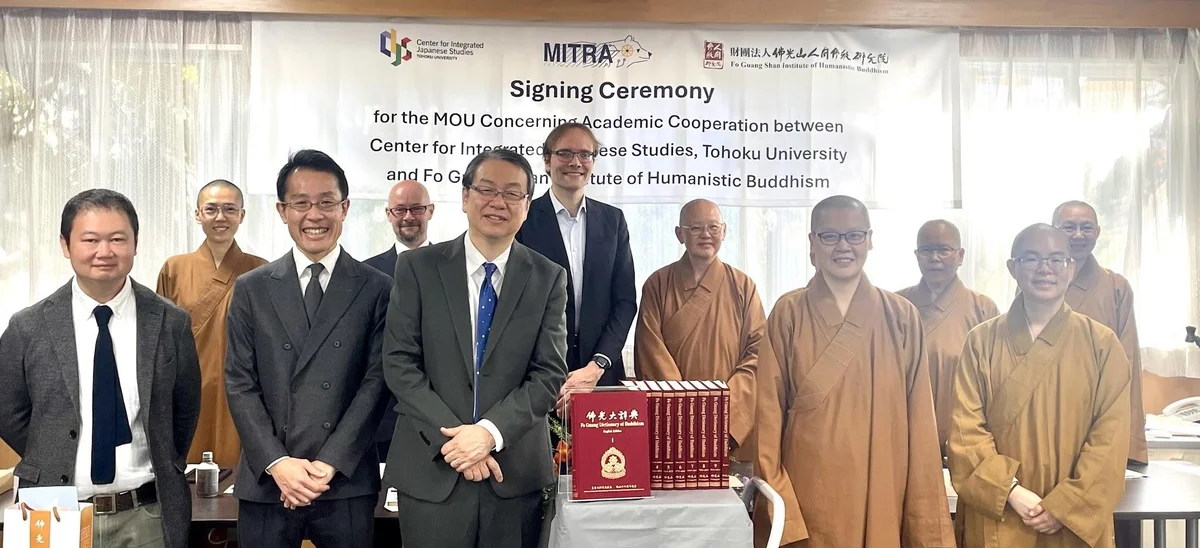
To further advance the research, development, and application of artificial intelligence (AI) in Buddhist text translation, Venerable Miao Guang, Deputy Chancellor of the Fo Guang Shan Institute of Humanistic Buddhism and Editor-in-Chief of the English edition of the Fo Guang Dictionary of Buddhism, led a Fo Guang Shan delegation to Sendai, Miyagi Prefecture, Japan, on November 4 to sign a Memorandum of Understanding (MoU) with the Center for Integrated Japanese Studies at Tohoku University. The agreement marks a new phase of collaboration between FoGuangAI and MITRA, the Buddhist AI translation project, bringing together academic expertise and technological resources to advance multilingual Buddhist text translation.
Since 2024, the Fo Guang Shan Institute of Humanistic Buddhism has collaborated with the MITRA research team, formerly based at the University of California, Berkeley. The partnership brought together MITRA’s multilingual Buddhist lexical database of more than three million entries and Fo Guang Shan’s bilingual corpus of approximately 230,000 entries drawn from Buddhist scriptures and Humanistic Buddhism literature to jointly develop FoGuangAI, an AI-powered Buddhist translation platform. With the MITRA research project now based at Tohoku University, the new agreement will further integrate the university’s academic strengths in Buddhist studies, Japanese studies, and digital humanities to advance the digitization of Buddhist literature and AI-assisted translation technologies.
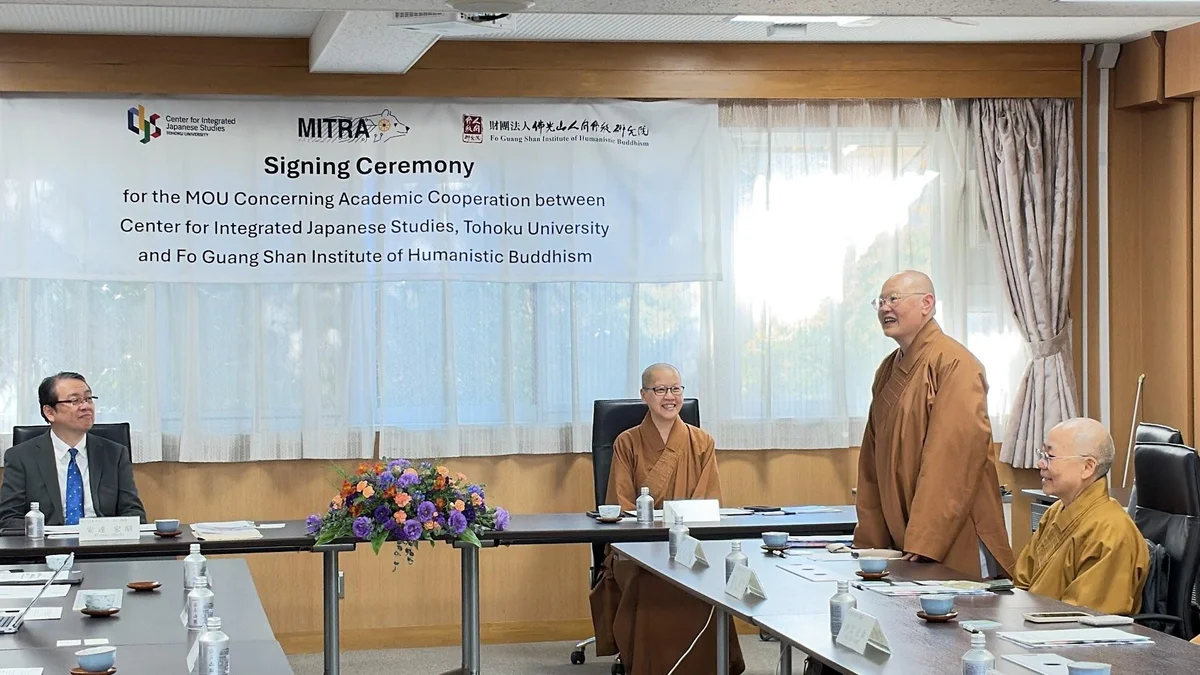
The signing ceremony took place at the Graduate School of Arts and Letters Building on Tohoku University’s Kawauchi-Minami Campus. The seven-member Fo Guang Shan delegation included Venerable Man Run, Head Abbess of the Fo Guang Shan Japan Region; Venerable Chueh Yong, Abbess of Fo Guang Shan Tokyo; Venerable Miao Chung, Superintendent of Fo Guang Shan Tokyo; Venerable Ru Di, Chief Secretary of the Fo Guang Shan Institute of Humanistic Buddhism in Japan; Venerable Zhi Yue of the Fo Guang Shan Institute of Humanistic Buddhism; and Venerable Ming Cheng of Fo Guang Shan Tokyo. Nine representatives from Tohoku University attended, including Professor Hiroaki Adachi, Director of the Center for Integrated Japanese Studies; Professor Satoshi Kato, Deputy Director; Professor Christopher Craig; Associate Professor Ryuta Kikuya; and Distinguished Assistant Professor Sebastian Nehrdich.
In his remarks, Professor Hiroaki Adachi expressed his pleasure in establishing a collaborative relationship between Tohoku University and Fo Guang Shan. He looked forward to bringing together the expertise and research resources of both institutions to create new opportunities for Buddhist studies and international academic exchange.
Venerable Miao Guang expressed her gratitude for Tohoku University’s support and highlighted Fo Guang Shan’s longstanding commitment to preserving, compiling, and translating Buddhist literature, including major projects such as the Fo Guang Dictionary of Buddhism and the Fo Guang Buddhist Canon. These initiatives reflect the importance that Fo Guang Shan’s founder, Venerable Master Hsing Yun, placed on preserving and transmitting Buddhist culture. She emphasized that the collaboration represents more than the continuation of the MITRA research project from Berkeley to Sendai. Through the responsible application of artificial intelligence, the partnership also seeks to establish a lasting foundation for Buddhist scholarship and cultural preservation in the decades ahead.
Venerable Man Run introduced the university system established by Fo Guang Shan and its longstanding contributions to Buddhist higher education. She expressed her hope that the new partnership would further strengthen cooperation in Buddhist education, academic research, and international exchange.
The collaboration will focus on the continued development and optimization of FoGuangAI. A key initiative involves plans to incorporate the English edition of the Fo Guang Dictionary of Buddhism, scheduled for official publication on November 9, into the AI model’s training. By drawing upon the dictionary’s extensive Buddhist terminology, scriptural contexts, and doctrinal explanations, the project aims to improve translation accuracy and terminological consistency, enabling Buddhist translators to work more efficiently across multiple languages.
Following the signing ceremony, the Fo Guang Shan delegation visited Tohoku University Library to view its collection of the Derge edition of the Tibetan Buddhist canon and learn about the university’s Buddhist text digitization initiatives. The delegation also visited Tohoku University Archives to gain insight into the institution’s history and academic development.
From Berkeley, United States, to Sendai, Japan, the collaboration between FoGuangAI and MITRA continues to deepen. By bringing together Buddhist textual resources and artificial intelligence technologies, the partnership seeks to transcend linguistic and cultural barriers and make Buddhist wisdom accessible to audiences around the world.
評論(0)
目前沒有評論,歡迎分享您的看法。
登入會員後即可發表評論、回覆及讚。