


Article: Fo Guang Shan Institute of Humanistic Buddhism
Photo credits: Fo Guang Shan Institute of Humanistic Buddhism
Fo Guang Shan Institute of Humanistic Buddhism and MITRA (Buddhist AI Translation) have officially released FoGuang AI version 2.0, marking a significant upgrade to this Buddhist AI translation platform. The new version is specifically designed for the translation of Buddhist sutras, The Complete Works of Venerable Master Hsing Yun, Fo Guang Shan's foreign-language news, and contemporary literature into modern languages. It marks a new stage for Buddhist translation, defined by the collaboration between AI and professional translators, serving practitioners, scholars, and devotees worldwide.
This project began in June 2024, when the FGS Institute of Humanistic Buddhism signed a cooperation agreement with the MITRA project, which was then housed at the Berkeley Artificial Intelligence Research (BAIR) Lab at the University of California, Berkeley. Both parties aim to utilize AI technology to help the Buddhist canon and The Complete Works of Venerable Master Hsing Yun transcend linguistic barriers and reach more contemporary readers, thereby integrating the wisdom of Buddha's teachings with technological innovation.
This collaboration combines two vital resources: first, MITRA's long-standing Buddhist AI translation technology and its collection of over three million parallel text segments in Sanskrit, Pali, Tibetan, and Chinese; and second, the FGS Institute of Humanistic Buddhism's database of 300,000 corpus entries, which encompasses the Buddhist canon, The Complete Works of Venerable Master Hsing Yun, and bilingual Humanistic Buddhism materials in Chinese and English, providing a robust foundation for the Buddhist translation model. Notably, FoGuang AI is not a general-purpose AI translation tool, but a specialized large language model trained with Humanistic Buddhism texts as its core.
Key feature of FoGuang AI: precisely translate Fo Guang Shan specialized terminology and Humanistic Buddhism terms.
The greatest strength of FoGuang AI lies in its ability to accurately translate Fo Guang Shan's specialized terminology and the technical vocabulary of Humanistic Buddhism. The system has comprehensively learned from the Buddhist terminology, translation conventions, and contexts of Dharma propagation accumulated by Fo Guang Shan over many years. It is capable of precisely identifying terms related to Humanistic Buddhism within their specific contexts, thereby avoiding the common mistranslations often found in general-purpose AI. This allows Fo Guang members worldwide to share information about Humanistic Buddhism in English and other languages with peace of mind, further enhancing the quality of international Dharma propagation and cultural exchange.
FoGuang AI version 2.0 is guided by Venerable Miao Guang, Deputy Chancellor of the FGS Institute of Humanistic Buddhism, with Venerable You Zai overseeing digital infrastructure and the compilation of Humanistic Buddhism datasets, and Venerable Zhi Yue leading the platform's overall design and interface development. The Institute provides the lexical database and translation conventions to ensure that the system's output remains consistent with the vocabulary of Fo Guang Shan Humanistic Buddhism. Dr. Alex Amies, a software engineer at Google, serves as the technical expert assisting in the integration of system components, while Dr. Sebastian Nehrdich, Assistant Professor at the Center for Integrated Japanese Studies at Tohoku Universityand CTO of the MITRA project, provides the backend development and translation model training.
Through continuous development, FoGuang AI has evolved from a simple translation tool into an intelligent platform that integrates translation, editing, quality assessment, and vocabulary management. In addition to improving translation efficiency, it ensures consistency in the teachings of the Buddha and the accuracy of specialized terminology. The upgraded interface allows translators to grasp translation styles with even greater precision.
A Brand New Interface Upgrade
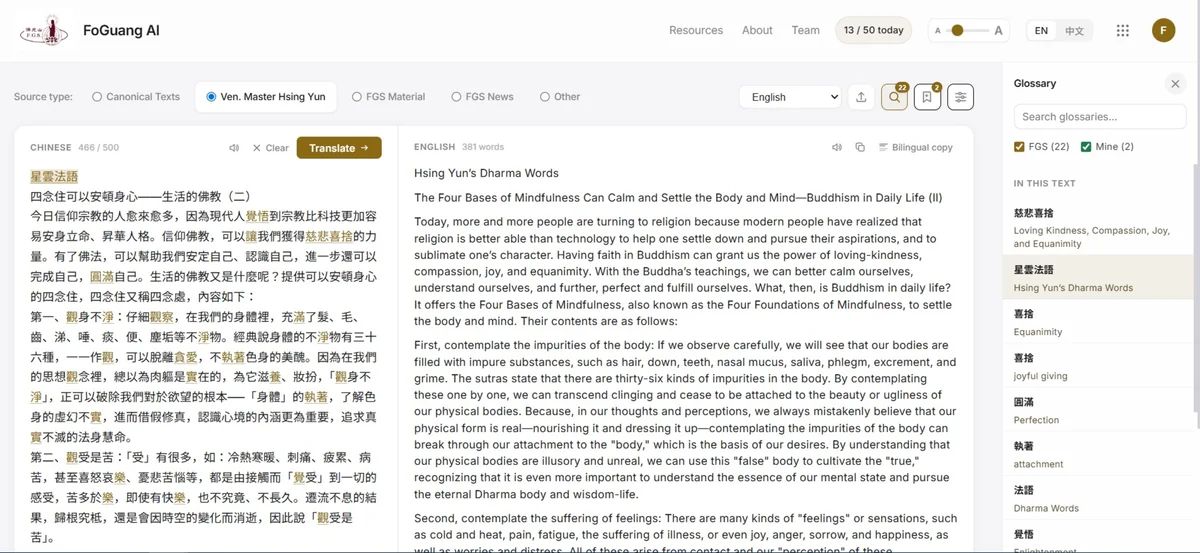
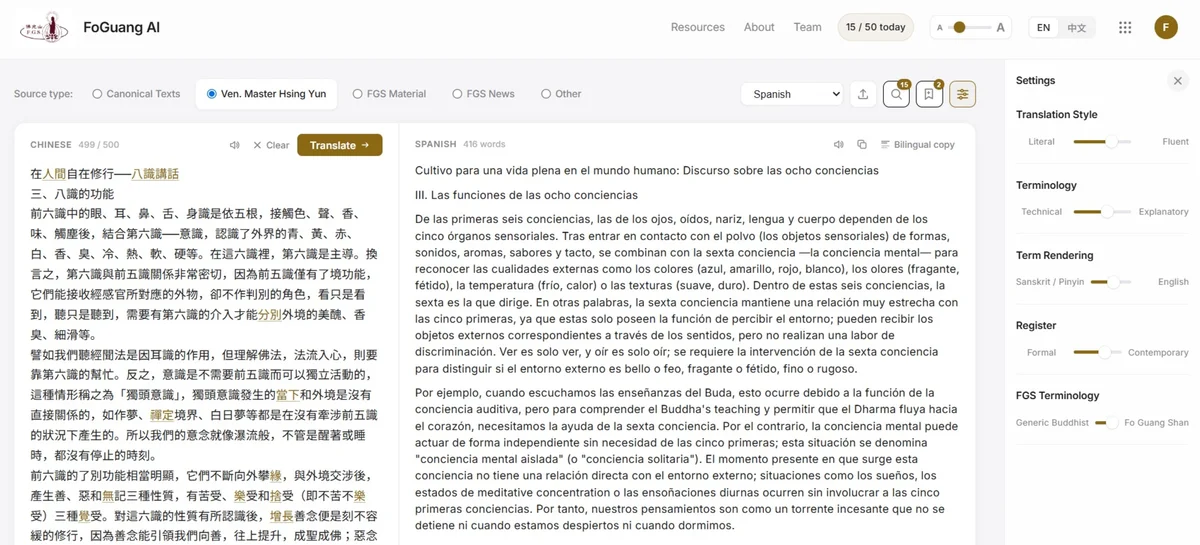
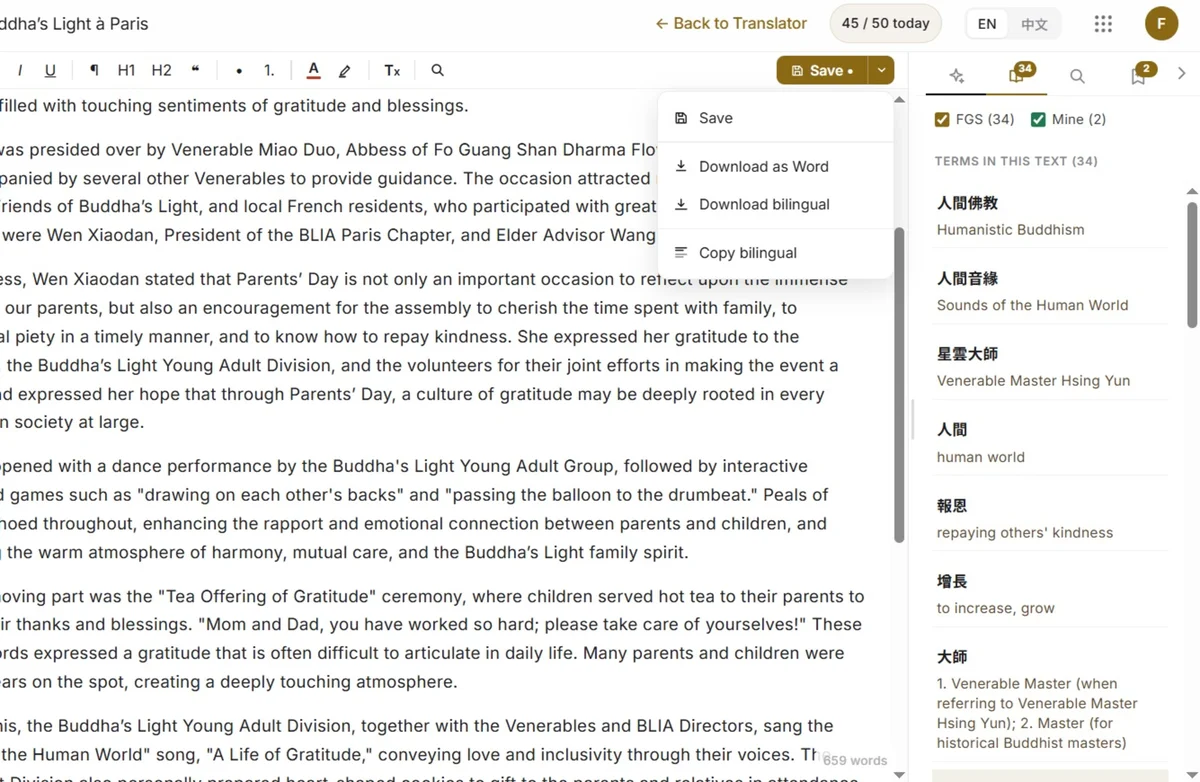
A major highlight of FoGuang AI 2.0 is its newly designed translation interface. Users can first select the type of text, such as Buddhist sūtras, The Complete Works of Venerable Master Hsing Yun, Fo Guang Shan news, or materials related to Humanistic Buddhism. They can then adjust the translation style according to their needs, including the balance between literal and free translation, the depth of technical terminology, the presentation of Sanskrit terms, the level of formality, and the application of established Fo Guang Shan terminology.
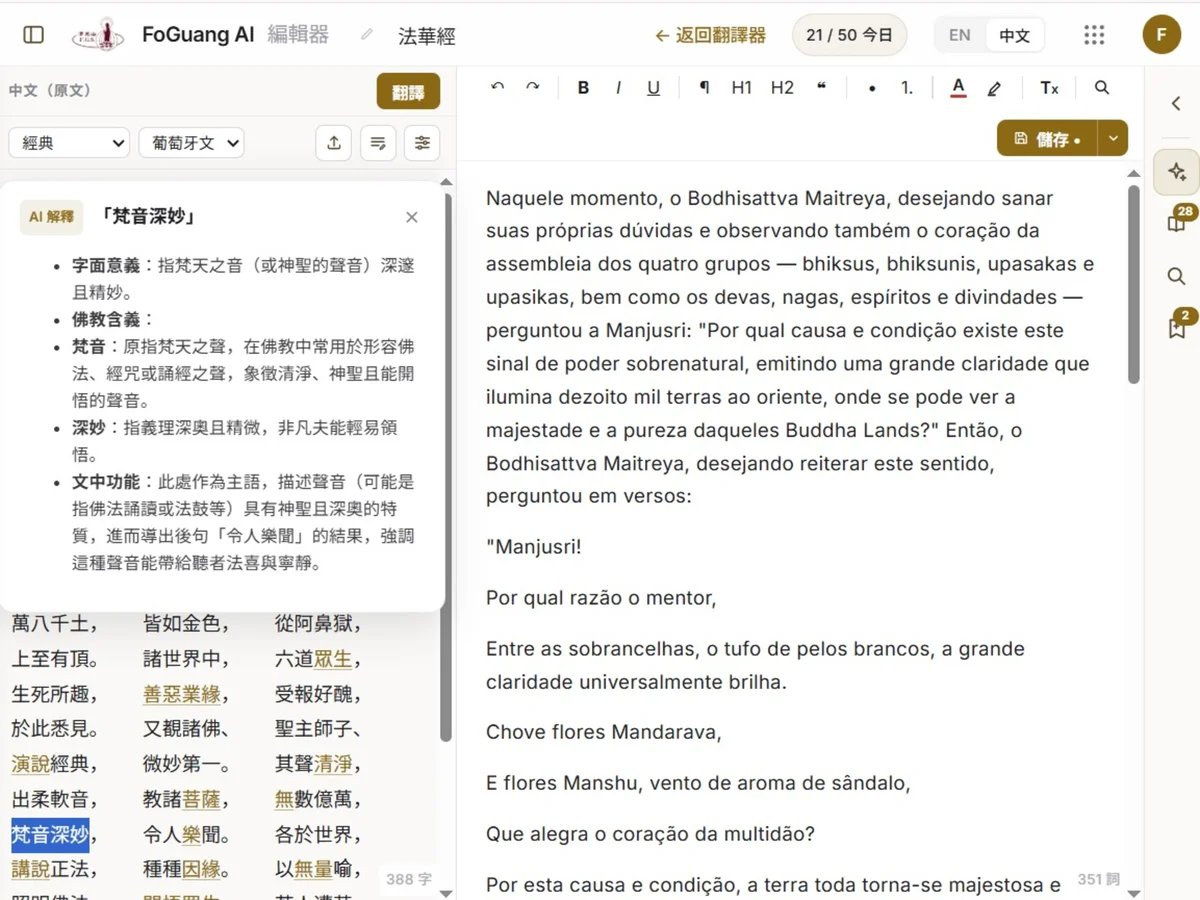
At the same time, the platform features a built-in contextual vocabulary explanation function. By simply clicking on a word, users can receive AI-generated analysis and explanations based on the context, helping translators gain a deeper understanding of the original text's nuances to produce more accurate and tailored translations.
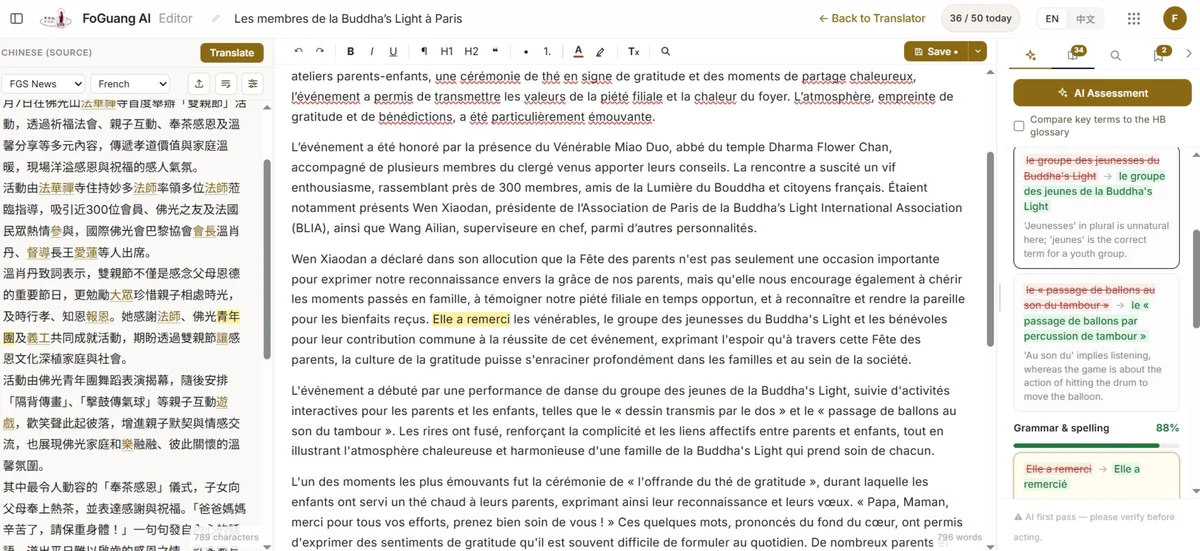
Beyond its translation functions, the platform also provides a comprehensive editorial environment. Users can create and manage personal documents, enter or paste content directly, or upload PDF, Word, image, and text files. Through Optical Character Recognition (OCR) technology, the system can automatically extract and translate text. Users can complete the processes of translation, editing, and exporting documents within the same platform, while enjoying features such as auto-save, word count, and bilingual side-by-side output. The platform also introduces a translation quality assessment function, which provides a comprehensive analysis based on the original Chinese text, evaluating factors such as fidelity, fluency and readability, grammar and spelling, consistency in terminology, and adherence to the official Fo Guang Shan glossary.
Beyond providing independent scoring for various indicators and an overall assessment, the system automatically identifies areas in the translation that require revision, explaining the reasons and offering specific suggestions. By cross-referencing these with the original text, it assists translators in quickly grasping what needs adjustment, serving as an essential reference for revision and quality control. Users may also incorporate custom assessment criteria to ensure the analysis better aligns with the translation requirements of different texts.
Regarding vocabulary management, FoGuang AI 2.0 has established a terminology system that combines personalized use with community sharing. Translators can create individual glossaries and prioritize their preferred translations; they may also submit high-quality entries, which, upon verification, will be integrated into the official Humanistic Buddhism glossary to collectively refine Buddhist translation resources. Within the next six months, FoGuang AI will progressively launch multilingual functions for Spanish, French, German, and Portuguese, further expanding the scope of its services. In the future, users from diverse linguistic backgrounds across the globe will be able to more conveniently study Buddha's teachings, consult Buddhist knowledge, and participate in translation work through the platform, together promoting Humanistic Buddhism across linguistic and cultural boundaries, allowing the wisdom of Buddha's teachings to reach every corner of the world.
Venerable Master Hsing Yun, the founder of Fo Guang Shan, dedicated his life to promoting Buddha's teachings through culture and education. FoGuang AI 2.0 is a continuation of this vow in the digital age. By utilizing modern technology to carry the wisdom of Buddha's teachings, it allows Humanistic Buddhism to transcend linguistic and geographical boundaries, creating new possibilities for global Buddhist cultural exchange and Dharma propagation.
FoGuang AI 2.0 is now officially open for use, providing free access to Buddhist translators.
Fo Guang ai: http://foguang.ai
評論(0)
目前沒有評論,歡迎分享您的看法。
登入會員後即可發表評論、回覆及讚。