


By Fo Guang Shan Institute of Humanistic Buddhism
Photos by Venerable Hui He and Chang Fu-Chieh
Diverse Themes Highlight the Development of Humanistic Buddhism
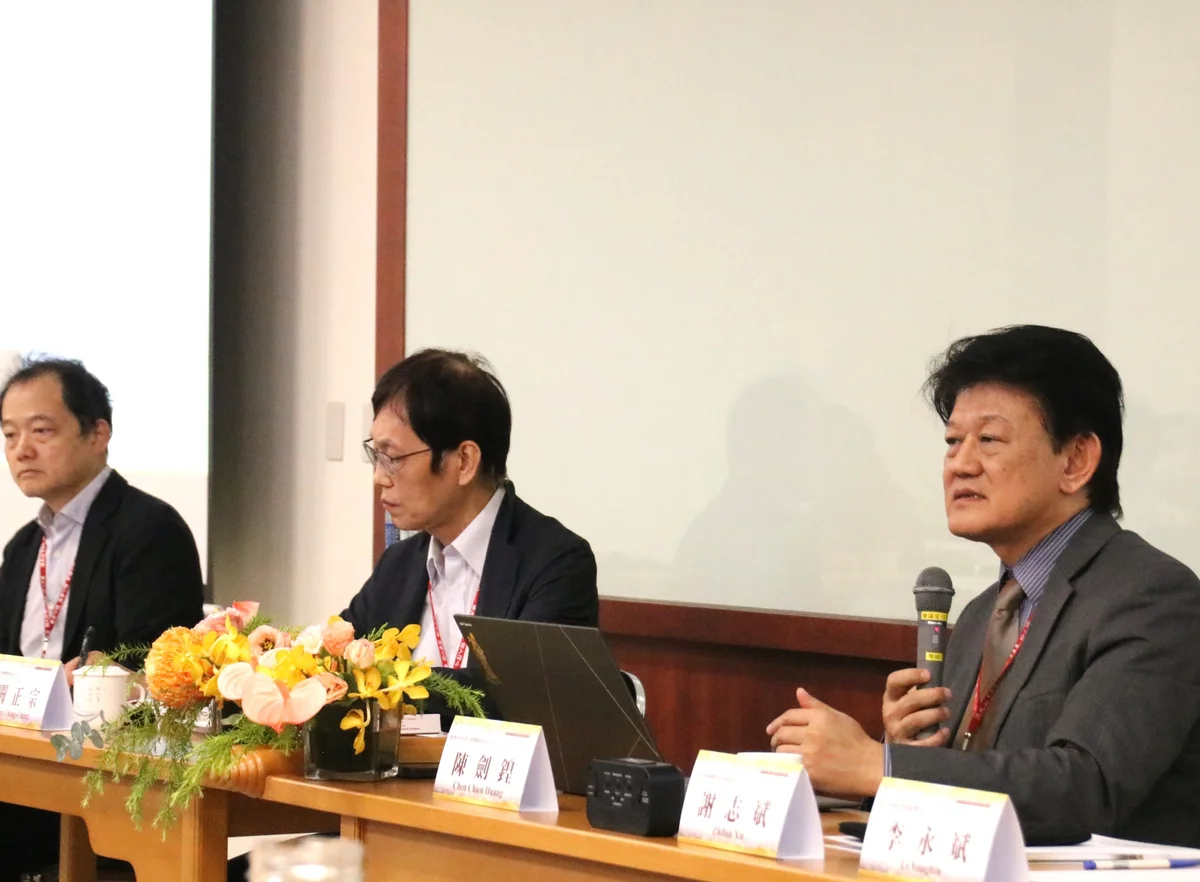
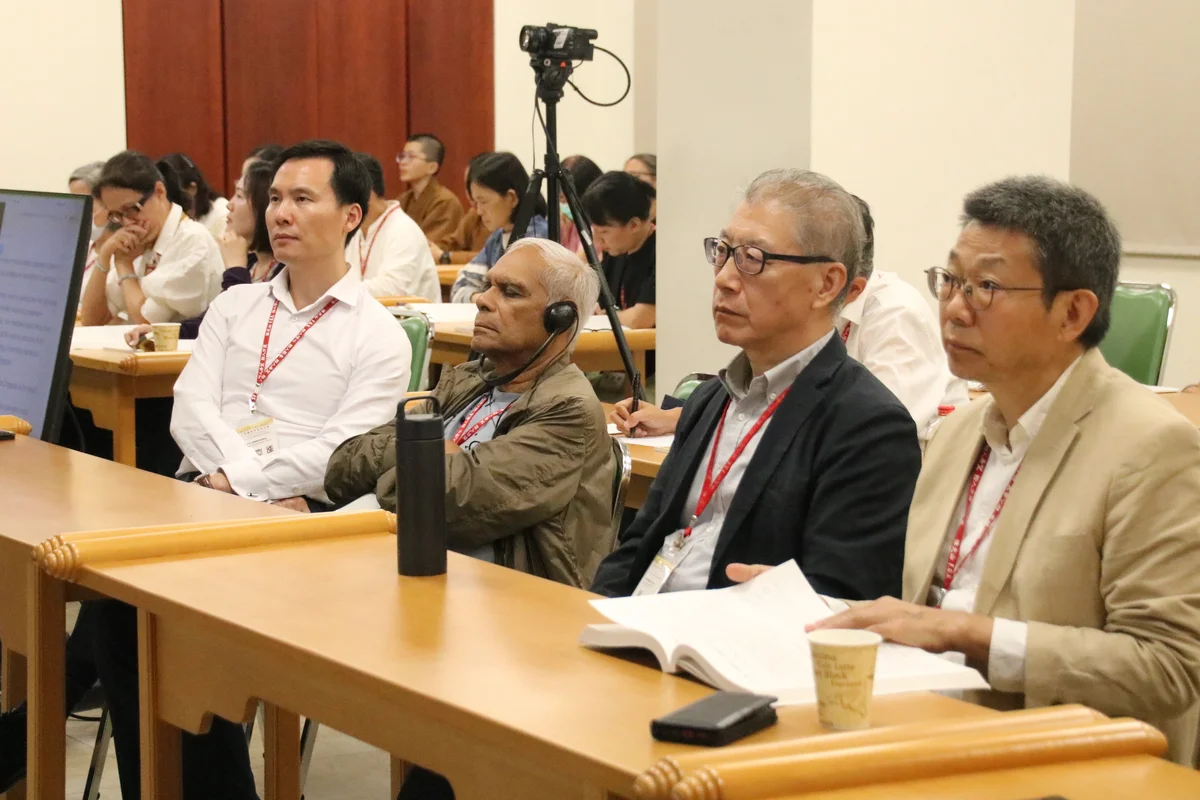
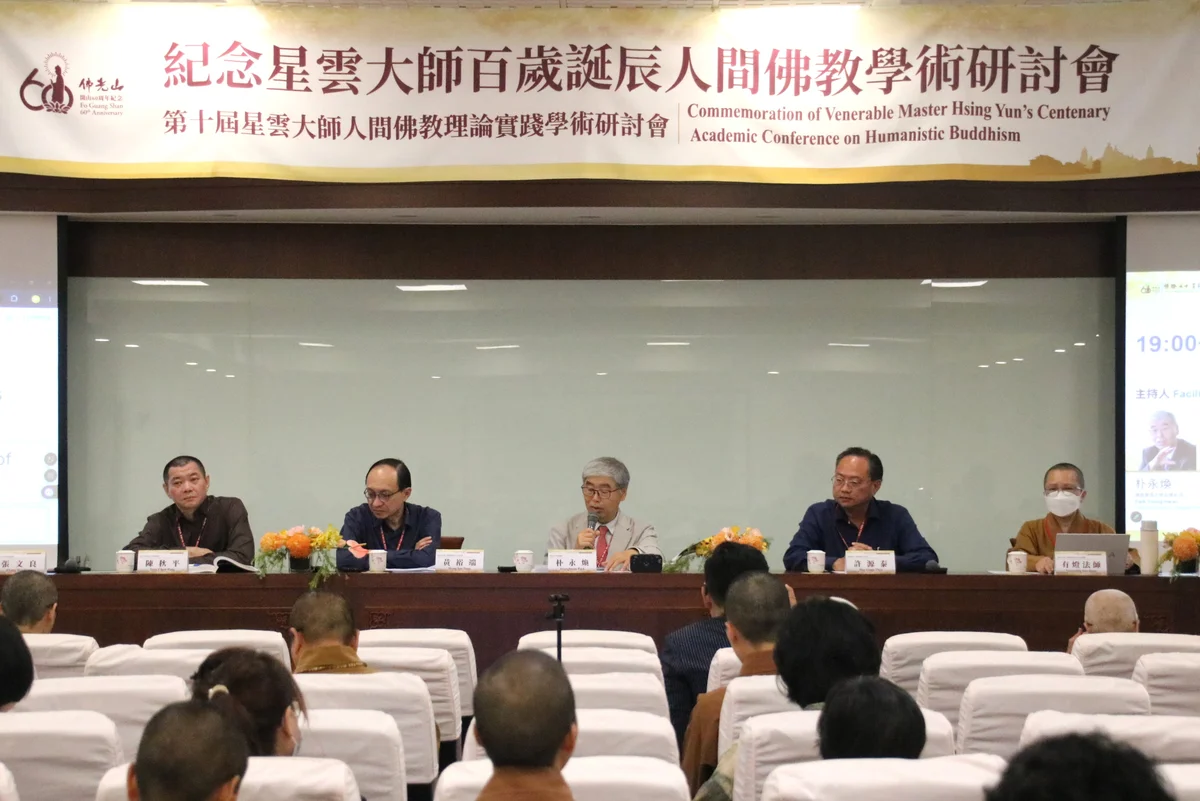
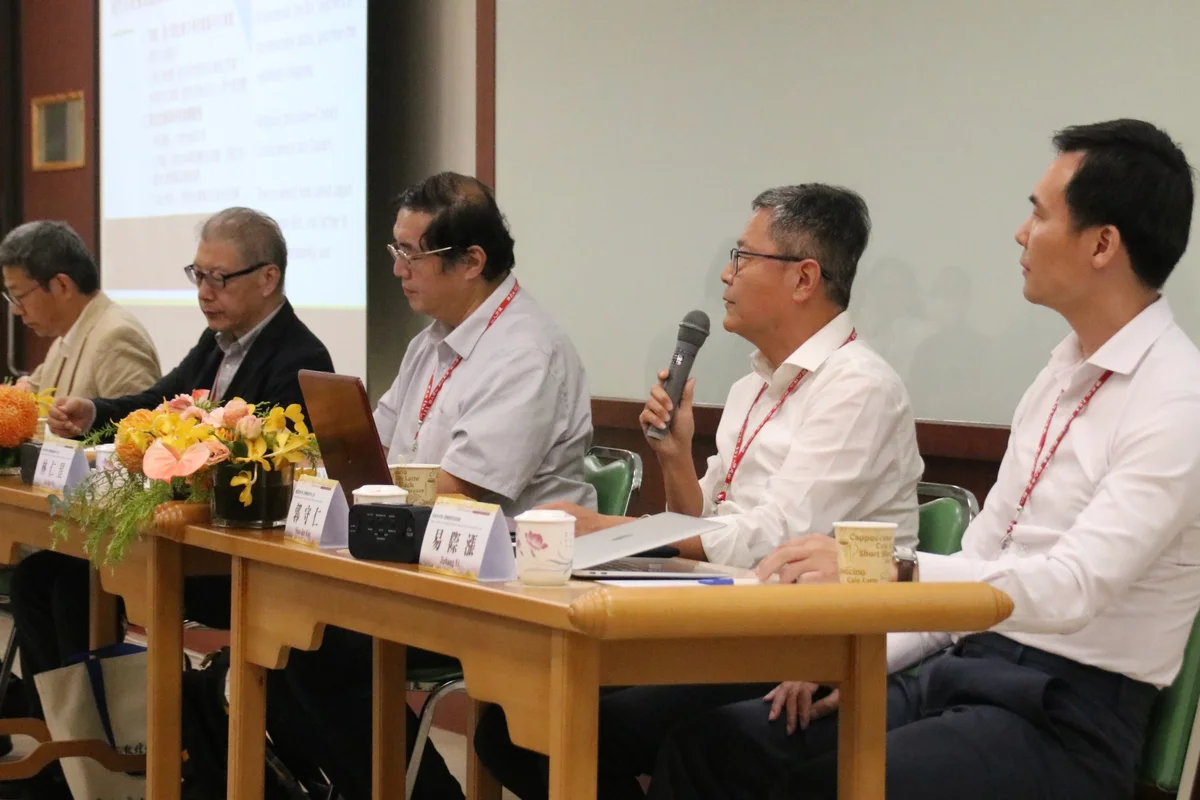
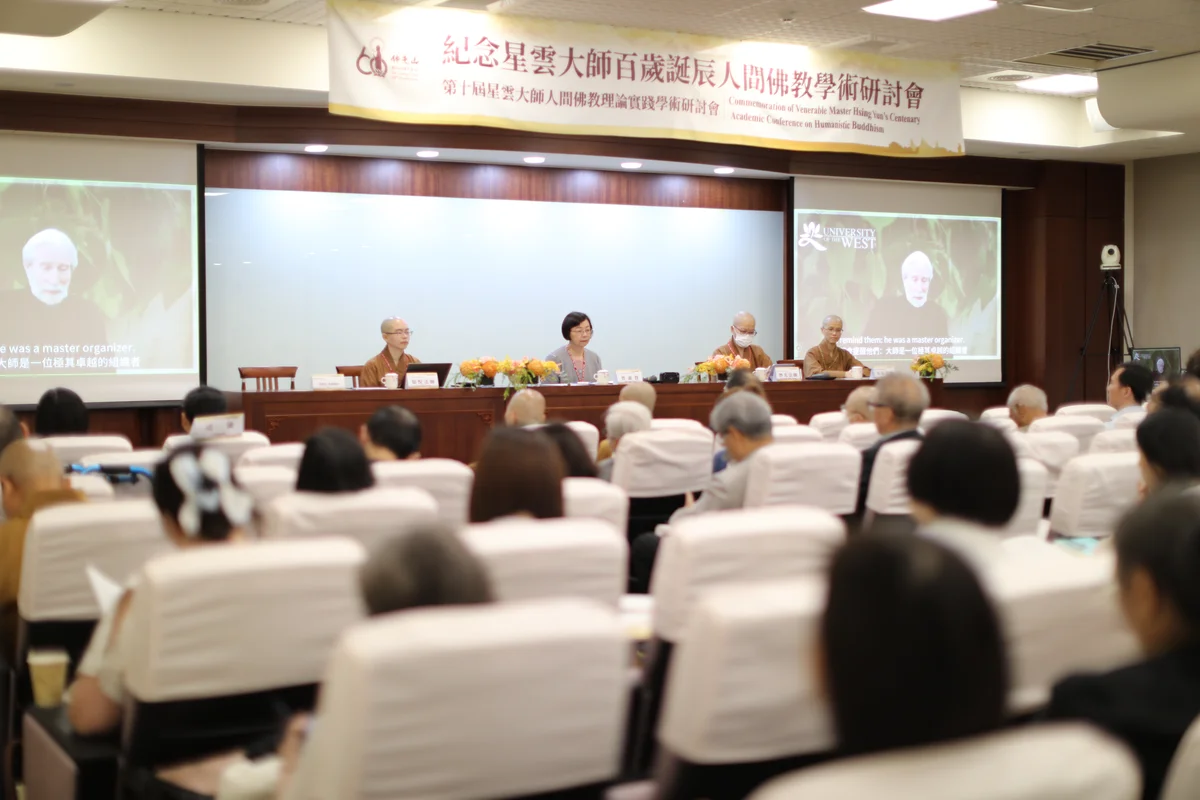
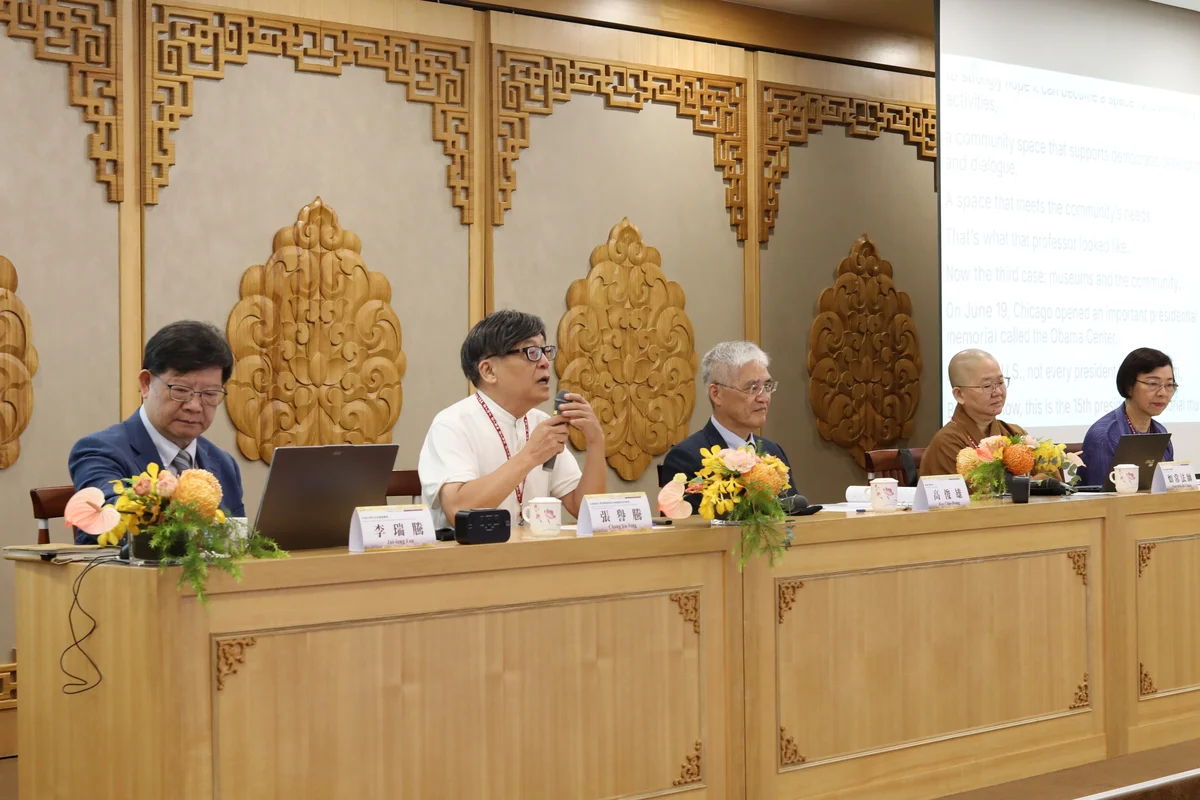
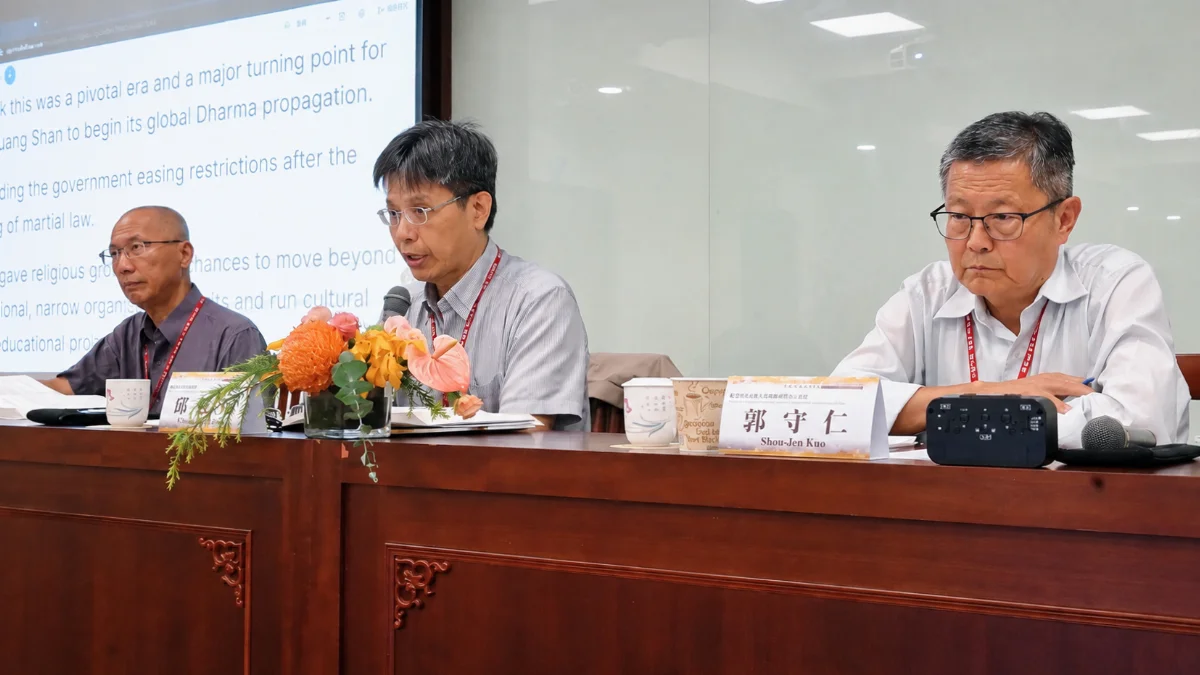
The Commemoration of Venerable Master Hsing Yun’s Centenary Academic Conference on Humanistic Buddhism, held in conjunction with the 10th Academic Conference on the Theory and Practice of Venerable Master Hsing Yun’s Humanistic Buddhism, took place at Fo Guang Shan from August 21 to 23, 2026.
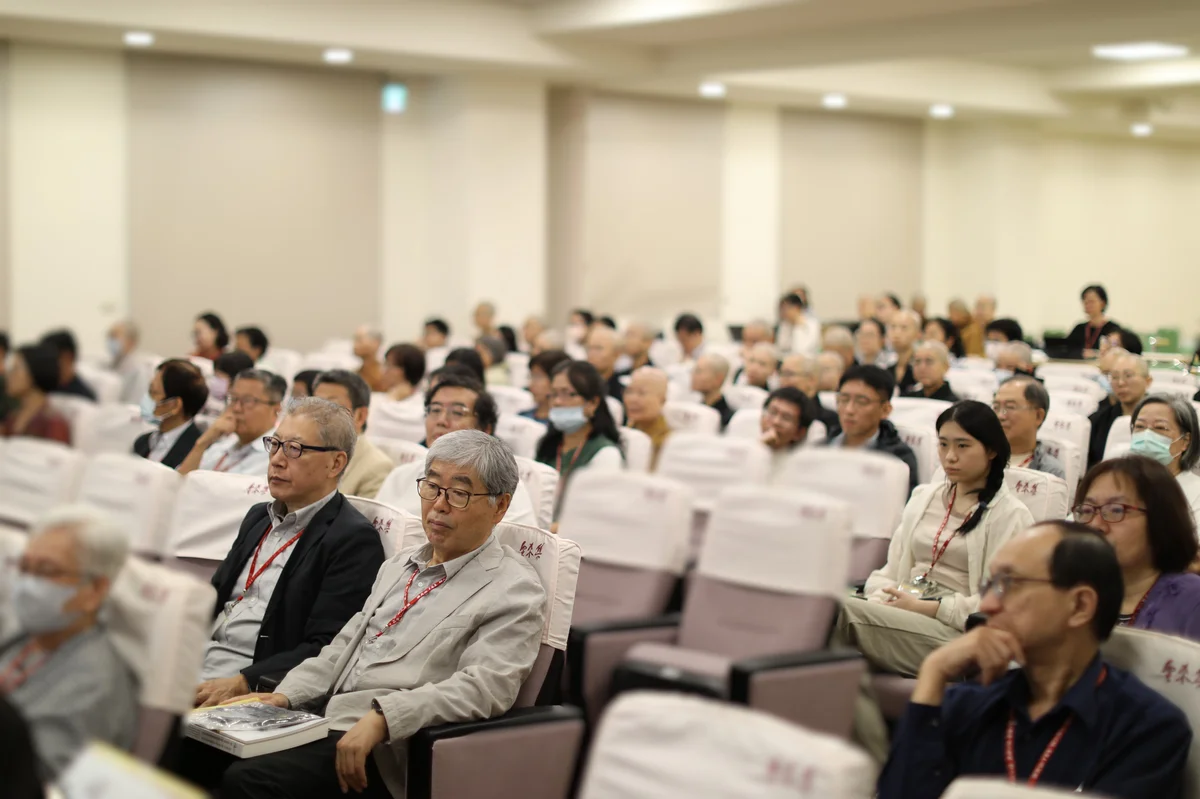
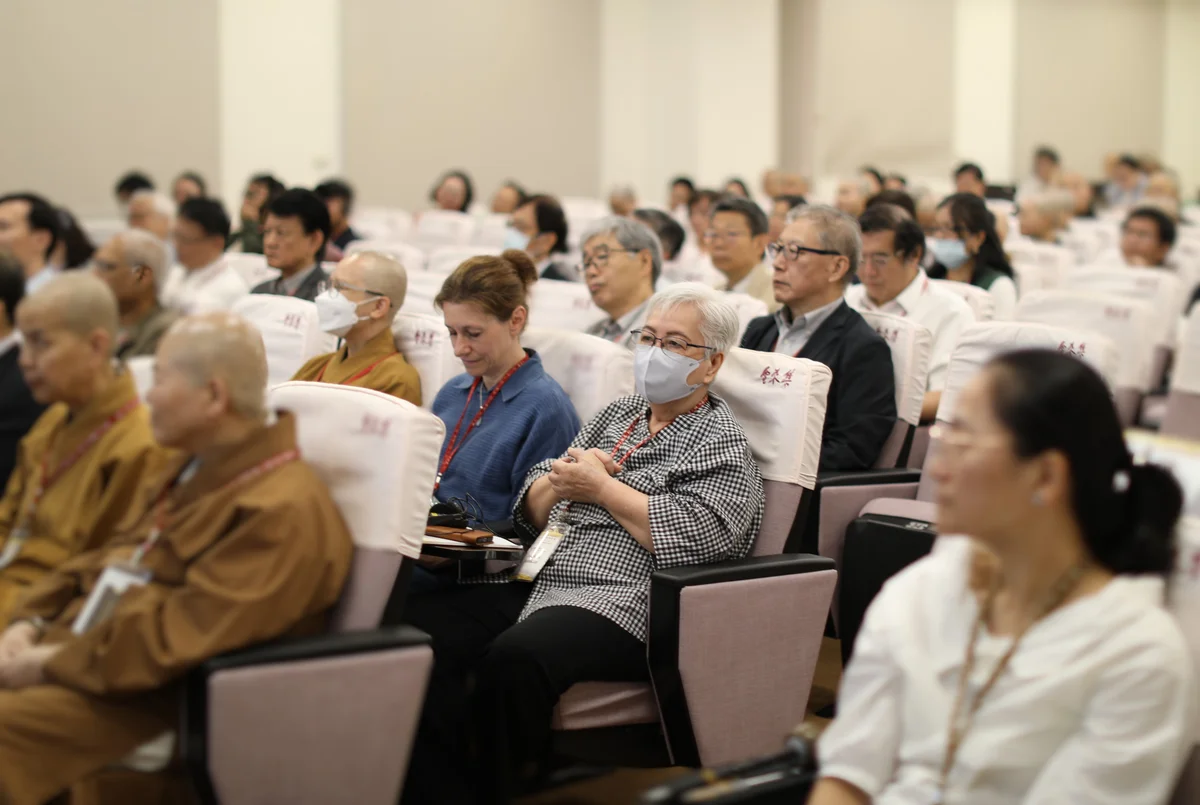
Scholars from 11 countries and regions participated, representing more than 30 universities and research institutions, including Academia Sinica, National Cheng Kung University, the University of Toronto, the University of Hong Kong, the Chinese University of Hong Kong, SOAS, Aoyama Gakuin University, and the University of California, Berkeley.
In addition to two keynote speeches, the conference featured 11 thematic panels and 50 paper presentations. Topics included Venerable Master Hsing Yun’s thought on Humanistic Buddhism, contemporary society, academic development, monastic education, the global history of Dharma propagation, Buddhist digital humanities, cultural and artistic practice, and future directions.
The panels examined the development of Humanistic Buddhism across the fields of thought, education, culture, institutional development, and global Dharma propagation, while also addressing emerging issues related to digital technology and artificial intelligence.
Humanistic Buddhist Thought in Contemporary Society
Panels 1, 2A, and 2B focused on the intellectual foundations and contemporary development of Humanistic Buddhism.
Presenters examined the development of Venerable Master Hsing Yun’s thought from the 1960s onward and discussed its significance in the context of globalization. Other presentations explored comparative religion, ethics, contemporary education, and artificial intelligence.
Several papers considered AI in relation to education and communication, as well as Buddhist concepts such as skillful means (upāya) and the role of a “spiritual friend” (kalyāṇamitra), extending discussion of Humanistic Buddhism into contemporary technological contexts.
Monastic Education and Dharma Propagation
Panel 5, “Research on Monastic Education in Fo Guang Shan,” reviewed six decades of educational development beginning with the establishment of Shoushan Buddhist College in 1965.
Presentations examined educational philosophy, daily-life education, intellectual formation, and lifelong learning. They discussed how Venerable Master Hsing Yun developed a system of monastic education integrating Buddhist study and practice, character formation, and practical training for Dharma propagation.
The panel also highlighted the role of monastic education in supporting Fo Guang Shan’s subsequent development and international Dharma propagation.
Diverse Paths of Global Dharma Propagation
Panels 3A, 3B, 7A, and 7B focused on the global development of Fo Guang Shan, with case studies from Malaysia, Japan, Singapore, Oceania, South America, the Philippines, and Europe.
Presentations showed how Fo Guang Shan adapted its approaches to different languages, ethnic communities, cultural traditions, and institutional environments through education, cultural activities, charitable work, the arts, and public engagement.
Studies of Fo Guang Shan in the Philippines examined the development of Dharma propagation, temple communities, cultural translation, social engagement, and localized practice, while research on Europe addressed transnational religious networks, localization, and the formation of Buddhist publics. Together, the presentations demonstrated the varied forms taken by Humanistic Buddhist practice in different cultural settings.
Digital Humanities and the AI Era
Panel 4, “Fo Guang Dictionary of Buddhism: Origins of the English Edition, Textual Transmission, and Knowledge Systems Construction,” examined the development of Buddhist knowledge from English translation and textual transmission to digital platforms, AI applications, and knowledge systems.
Presenters discussed how digital technologies can support search, linking, knowledge discovery, AI-assisted editorial processes, and translation quality evaluation.
The panel situated AI within the broader development of Buddhist digital humanities, examining how new technologies may assist the organization, translation, research, and transmission of Buddhist knowledge.
Cultural Practice and Public Engagement
Panel 6, “The Future Development of Humanistic Buddhism,” examined Buddhist weddings, cultural philanthropy, and the Fo Guang Buddhist Canon, addressing the ways Buddhist teachings are expressed in family life, social engagement, and the transmission of canonical texts.
Panel 8, “Propagation of Humanistic Buddhism through Arts and Culture,” focused on museums, the Cloud and Water Mobile Library, sports, and literature, presenting different forms of Fo Guang Shan’s practice of “propagating the Dharma through culture.”
These studies highlighted the role of cultural and educational initiatives in bringing Buddhist teachings into contemporary society.
Looking Toward Future Development
Across the 11 panels, scholars examined the development of Humanistic Buddhism through intellectual thought, education, cultural practice, knowledge transmission, and localized forms of Dharma propagation.
The discussions also addressed new questions arising from artificial intelligence, digital knowledge systems, and changing social conditions, while emphasizing the continuing importance of doctrinal foundations, scholarly verification, and adaptation to different cultural contexts.
Through historical studies and contemporary case analyses, the conference provided a review of the global development of Venerable Master Hsing Yun’s Humanistic Buddhism and opened further discussion on its future development in a changing technological and social environment.
Panel 1: Venerable Master Hsing Yun’s Philosophy of Humanistic Buddhism — From Global Vision to Ethics and Education
By Venerable Zhi Mu
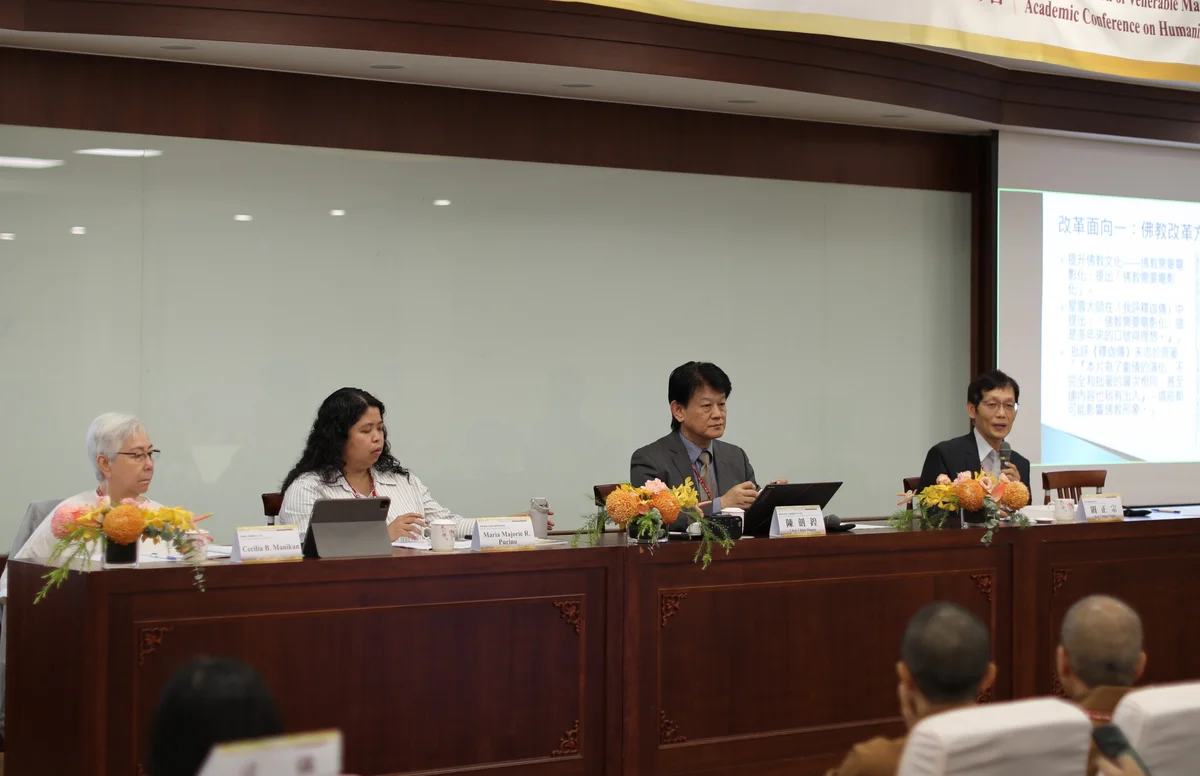
Panel 1, held on August 21 under the theme “Venerable Master Hsing Yun’s Philosophy of Humanistic Buddhism,” was chaired by Dr. Chen Chien Huang, Director of the Centre for the Study of Humanistic Buddhism at The Chinese University of Hong Kong. Presentations were delivered by Dr. Li Li’an, Director of the Institute of Buddhist Studies at Northwest University; Dr. Cheng-Chung Kan, Director of the Department of Buddhist Studies at Fo Guang University; Dr. Maria Majorie R. Purino, Professor in the Department of Philosophy at the University of San Carlos; and Dr. Cecilia B. Manikan, Director of the Humanistic Buddhism Center in the Philippines. Their papers approached Venerable Master Hsing Yun’s Humanistic Buddhist thought through globalization, intellectual history, comparative ethics, and educational practice. More than 200 scholars and researchers participated onsite and online.
Dr. Li Li’an opened the session with an online presentation titled “A Three-Stage Framework for the Realization of the Values of Humanistic Buddhism in the Context of Globalization: Centered on Venerable Master Hsing Yun’s Relevant Discourses.” Dr. Li identified expanding material desire, a loss of meaning, and ecological imbalance among the challenges confronting contemporary society, while also noting the limitations arising from the historical separation of the Theravāda, Chinese, and Tibetan Buddhist traditions.
Dr. Li argued that Venerable Master Hsing Yun’s Humanistic Buddhism should be understood not simply as a popularization or modernization of Buddhism, but as a project of civilizational reconstruction. He summarized its mission in three directions: inward, toward culture, and toward the world. Moving inward involves reconstructing a more unified form of global Buddhism; moving toward culture draws on Confucian and Daoist resources alongside Buddhist thought to allow Eastern wisdom to contribute to modern civilization; and moving toward the world calls for dialogue among diverse civilizations. Dr. Li maintained that this framework enables Humanistic Buddhism to contribute spiritual and practical guidance toward a more harmonious and mutually sustaining human civilization.
Dr. Cheng-Chung Kan presented “Venerable Master Hsing Yun’s Blueprint for Humanistic Buddhism in the 1960s.” Drawing on materials published in Awakening the World Periodical between 1962 and 1967, Dr. Kan traced the early formation of Venerable Master Hsing Yun’s ideas on Humanistic Buddhism and their gradual development into concrete institutional practice.
After assuming responsibility for the periodical, Venerable Master Hsing Yun advocated an editorial approach centered on being “new,” “practical,” and “simple.” Through his writings, he proposed reforms including the abolition of the temple-manager system, the standardization of monastic attire, changes to traditional Dharma assemblies, and improvements in monastic education. The founding of Shoushan Buddhist College in 1965 and Fo Guang Shan in 1967 further demonstrated how these ideas were progressively translated into practice. Dr. Kan observed that Fo Guang Shan’s later development was therefore not accidental, but the result of years of accumulated thought and sustained implementation.
Dr. Maria Majorie R. Purino presented “Beyond the Surface: Kantian Good Will, Humanistic Buddhism’s Three Acts of Goodness, and the Problem of Superficial Morality.” From the perspective of comparative philosophy, Dr. Purino placed Kant’s concept of “good will” in dialogue with the Three Acts of Goodness—doing good deeds, speaking good words, and thinking good thoughts.
In a society increasingly shaped by online fraud, artificial intelligence, and deepfake technologies, Dr. Purino noted that outwardly good behavior can be imitated or manufactured. Ethical judgment, therefore, cannot rest solely on visible actions but must also consider the motivation and intention behind them. Drawing on Kant’s emphasis on good will and the Buddhist concept of cetanā, or volition, Dr. Purino highlighted “thinking good thoughts” as the internal ethical foundation of moral conduct. From this perspective, genuine goodness requires not only appropriate outward behavior, but also sincere and wholesome intention.
Dr. Cecilia B. Manikan presented “Operationalizing Venerable Master Hsing Yun's Vision of Holistic Education: An Integrative Outcome-Based Curriculum through the Whole-Brain Self-Mastery Framework.” Her paper explored how the educational ideals of Humanistic Buddhism can be translated into curriculum design and measurable learning outcomes in higher education.
Drawing on the experience of Guang Ming College in the Philippines, which began integrating the Whole-Brain Self-Mastery (WBSM) framework into its curriculum in 2017, Dr. Manikan explained how Humanistic Buddhist principles can guide students’ intellectual, moral, emotional, and social development. The framework integrates dimensions including thinking, doing, feeling, communicating, intuiting, leading, and being, while linking educational goals with students’ overall development.
Dr. Manikan emphasized that education should help learners discover their inherent Buddha-nature, develop self-confidence, and cultivate the capacity to contribute to a harmonious society. Her case study demonstrated that Humanistic Buddhist values need not remain at the level of philosophical ideals, but can be translated into concrete and assessable learning processes within contemporary higher education.
Together, the four presentations moved from the realization of Humanistic Buddhist values in a global context to the historical formation of Venerable Master Hsing Yun’s thought in the 1960s, before extending to ethical questions in the age of emerging technologies and the application of Humanistic Buddhist principles in higher education.
Through global dialogue, historical inquiry, comparative ethics, and educational practice, Panel 1 highlighted both the historical development of Venerable Master Hsing Yun’s Humanistic Buddhist thought and its capacity to respond to contemporary social concerns. The session opened the conference by bringing theory and practice into dialogue and demonstrating the continuing relevance of Humanistic Buddhism in the modern world.
Panel 2A: Humanistic Buddhism and Modern Society — From Interreligious Dialogue to AI and Family Education
By Jeanne H. Tuan
Panel 2A, held on August 21 under the theme “Humanistic Buddhism and the Modern Society,” was chaired by Dr. Syuan-yuan Chiou, Associate Professor in the Department of Sociology at National Chengchi University. Presentations were delivered by Dr. Abrahim H. Khan, Professor in the Faculty of Divinity at Trinity College, University of Toronto; Dr. Younghwan Park, Professor Emeritus at Dongguk University; Dr. Rong-Guan Dai, Assistant Professor at the General Education Center of National Taipei University of Technology; and Dr. Stefania Travagnin, Chair of the Centre of Buddhist Studies at SOAS University of London. Their papers addressed interreligious ethics, the modernization of East Asian Buddhism, parent-child education, and artificial intelligence, presenting multiple ways in which Humanistic Buddhism engages with contemporary society. Approximately 100 scholars and observers participated onsite and online.
Dr. Abrahim H. Khan presented “Cross-Cultural, Inter-religious Dialogue Overture: Buddhist Karuna/Ci-Bei as Christian Love of Neighbour?” Comparing Buddhist compassion with Christian neighbourly love, Dr. Khan examined both their common ethical concerns and their distinct religious foundations.
Dr. Khan noted that both traditions emphasize care for others and the ethical transformation of the individual, yet they arise from different philosophical frameworks. Buddhist compassion is grounded in dependent origination, emptiness, and prajñā wisdom, while Christian love of neighbour is closely connected with God, divine command, and the life of faith. Rather than eliminating such differences, Dr. Khan argued that meaningful interreligious dialogue begins by acknowledging them and then seeking possibilities for mutual understanding and shared ethical practice.
Dr. Younghwan Park presented “A New Perspective on A Critical Biography of Venerable Master Hsing Yun: Methodological Construction Centered on the ‘Humanistic Turn’ in Modern East Asian Buddhism.” Dr. Park situated Venerable Master Hsing Yun within the broader historical transformation of modern East Asian Buddhism as it moved from secluded monastic settings toward greater engagement with society and public life.
Dr. Park proposed four analytical dimensions—the “Humanistic Turn,” “Religious System Design,” “Knowledge Production,” and “Knowledge Circulation and Localization”—to explain how Venerable Master Hsing Yun developed modern Buddhist discourse through education, culture, charity, media, and global Dharma propagation networks. These processes also enabled Humanistic Buddhism to take root in different cultural contexts. From this perspective, Dr. Park described Venerable Master Hsing Yun not only as a religious leader, but as a “historical agent” who helped reshape the direction of modern East Asian Buddhism.
Dr. Rong-Guan Dai presented “Three Acts of Goodness, AI, Satir: An Educational Experiment in Human–Machine Collaboration for Parent–Child Communication.” His study brought together Venerable Master Hsing Yun’s Three Acts of Goodness—doing good deeds, speaking good words, and thinking good thoughts—with Satir’s communication theory and generative AI to explore how technology can help young people better understand family relationships.
Through role-play and reconstructed dialogue, students were guided to identify emotions, expectations, and underlying needs before translating their reflections into concrete communication. Dr. Tai emphasized that AI should not replace human thought or interpersonal relationships. Rather, it can serve as an “emotional buffer” that helps users organize their thoughts and rehearse difficult conversations. When guided by clear humanistic values such as the Three Acts of Goodness, he argued, technology can become an educational resource for cultivating empathy and self-reflection.
Dr. Stefania Travagnin presented “Artificial Intelligence from Upāya to Kalyāṇamitra: A Humanistic Buddhist Perspective.” She examined questions arising as AI moves beyond text search and digital learning tools into companionship and forms of religious engagement.
Dr. Travagnin noted that while AI can provide information, answer questions, and simulate interaction, it does not possess genuine cultivation experience, ethical responsibility, or lived human experience. For this reason, she cautioned against equating AI with a true kalyāṇamitra, or spiritual friend, whose guidance is grounded in personal practice and ethical commitment.
She further warned that excessive dependence on AI could weaken practitioners’ understanding of the Dharma and their own capacity for judgment, shifting from the Buddhist principle of “relying on the Dharma rather than the person” toward an overreliance on AI. Dr. Travagnin argued that the Humanistic Buddhist response to technological change should therefore be neither rejection nor uncritical acceptance, but a clear recognition of AI’s capabilities and limitations, with compassion, wisdom, collective practice, and human judgment serving as essential ethical boundaries.
Although the four presenters approached the subject from different academic and cultural perspectives, together they highlighted a defining characteristic of Humanistic Buddhism: its commitment to engaging with human life and responding to the needs of its time. Their discussions extended Humanistic Buddhist thought into interreligious dialogue, education, family relationships, technology, and global society, demonstrating its relevance to the practical challenges of a rapidly changing world.
Held during Fo Guang Shan’s 60th anniversary and the centenary of Venerable Master Hsing Yun’s birth, the conference brought together scholars across countries and disciplines to reflect on the global development of Humanistic Buddhism while opening new discussions on its role in the technological age, cross-cultural societies, and the future.
Panel 2B: The Philosophical Construction and Academic Development of Humanistic Buddhism — From Comparative Religion to Cross-Cultural Translation
By Venerable Zhi Mu
Panel 2B, held on August 21 under the theme “The Philosophical Construction and Academic Development of Humanistic Buddhism,” was chaired by Dr. Lin Jen-Yu, Professor in the Department of Chinese Literature and Chairman of the Art Center at National Chung Hsing University. Presentations were delivered by Dr. Shou-Jen Kuo, Director of the Institute for the Study of Humanistic Buddhism at the University of the West; Dr. Guang Xing, Professor at the Centre of Buddhist Studies at the University of Hong Kong; Dr. Jizhang Yi, Director of the Institute for Humanistic Buddhist Thought and Practice at the University of Toronto; and Dr. Jidong Chen, Professor at Aoyamagakuin University. Their papers approached Humanistic Buddhism through comparative religion, Buddhist education, comparative theology, and its propagation in Japan, examining how Humanistic Buddhism can develop contemporary academic discourse and cross-cultural frameworks. Approximately 70 scholars and observers participated onsite and online.
Dr. Shou-Jen Kuo presented “A Preliminary Discussion on the Development of Comparative Religious Studies of Humanistic Buddhism.” From a methodological perspective, Dr. Kuo examined how Humanistic Buddhism should be positioned within contemporary religious studies.
Dr. Kuo argued that research should avoid beginning with apologetic conclusions aimed at refuting other traditions or defending religious orthodoxy. Instead, it should meet contemporary academic standards of objectivity, verifiability, and comparative analysis while still taking seriously the sacred meanings and values internal to religious traditions. Drawing on frameworks such as Paul Tillich’s concept of “ultimate concern” and multidimensional approaches to religion, Dr. Kuo proposed establishing operational definitions, preserving the internal meanings of religious traditions, strengthening comparative methods, and encouraging rational dialogue across traditions and disciplines.
Rather than using comparison to establish religious superiority, Dr. Kuo emphasized that comparative religious studies can provide a framework for sustained and constructive dialogue while allowing Humanistic Buddhism to engage other traditions on academically credible terms.
Dr. Guang Xing presented “Humanistic Buddhism and Contemporary Education: A Discussion Centered on Yoniso Manasikāra.” Returning to early Buddhist scriptures, Dr. Guang examined the cognitive and educational significance of yoniso manasikāra, commonly understood as appropriate or wise attention.
Dr. Guang noted that while contemporary higher education places strong emphasis on critical thinking, Buddhist traditions likewise contain methods of learning grounded in rational observation, reflection, and seeing reality as it is. Yoniso manasikāra, he explained, is not merely a mode of intellectual understanding. In Buddhist cultivation, it plays a crucial role in overcoming the five hindrances, giving rise to the seven factors of enlightenment, realizing the Four Noble Truths, and progressing toward stream-entry.
For Dr. Guang, the challenge of contemporary Buddhist education is therefore not simply to increase knowledge about Buddhism, but to transform knowledge into a way of thinking and observing that can reshape one’s life. In this sense, education becomes a process through which intellectual understanding is internalized as lived wisdom.
Dr. Jizhang Yi presented “ ‘I Am Buddha’ as Awakening Seeking Understanding: Reconstructing Theology through Humanistic Buddhism.” Taking an existential-hermeneutical approach, Dr. Yi explored the possibility of placing Humanistic Buddhism in dialogue with theology beyond the boundaries of conventional theism.
Dr. Yi argued that “theology” need not be restricted to religious traditions centered on belief in God. It may also be understood more broadly as a religious tradition’s self-interpretation of its ultimate orientation. Tracing the development of theology from Aristotle through contemporary comparative theology, he emphasized that the concept has not always carried a fixed theistic definition.
Dr. Yi then interpreted Venerable Master Hsing Yun’s teaching “I Am Buddha” through the Chan Buddhist perspective of the nonduality of sudden awakening and gradual cultivation. He proposed that “I Am Buddha” can be read as an existential theological proposition within Humanistic Buddhism—one that joins awakening with self-understanding and lived practice. By placing “awakening seeking understanding” alongside Anselm’s formulation of “faith seeking understanding,” Dr. Yi opened a comparative dialogue between Buddhist and Western theological thought.
Dr. Jidong Chen presented “The Propagation of Humanistic Buddhism by Fo Guang Shan in Japan: Focusing on the Interactions between Dharma Propagators and Japanese Buddhist Scholars.” Examining the interactions between Fo Guang Shan monastics in Japan and Japanese Buddhist scholars, Dr. Chen explored the role of academic networks in the localization of Humanistic Buddhism.
Using the relationships with Japanese scholars Hajime Okayama and Koitsu Yokoyama as examples, Dr. Chen showed how monastics engaged in Dharma propagation served not only as religious teachers, but also as relationship builders and cultural translators. Japanese scholars, in turn, interpreted Humanistic Buddhism through their own intellectual traditions and academic vocabularies.
Dr. Chen argued that this two-way interaction illustrates an important mechanism of localization. Rather than a one-directional transfer of Buddhism from one cultural setting to another, localization involves the regeneration of meaning through local intellectual resources, academic networks, and sustained interpersonal exchange.
In concluding the session, Dr. Lin Jen-Yu observed that although the four presentations appeared to address different fields, they converged on a common question: how Humanistic Buddhism can develop forms of expression within contemporary academia that are understandable, verifiable, and open to dialogue.
Participants also exchanged views on the limits of academic objectivity, the appropriateness of using the concept of “theology” in a Buddhist context, and how religious autonomy might be maintained during processes of localization. These discussions underscored the broader challenge of constructing academic frameworks that remain rigorous while still respecting the internal meanings and lived dimensions of religious traditions.
Through comparative religion, Buddhist education, comparative theology, and cross-cultural propagation, Panel 2B demonstrated how Humanistic Buddhism can enter contemporary academic discourse without losing sight of its religious foundations. The session also highlighted the importance of developing research languages and methodologies capable of supporting dialogue across disciplines, traditions, and cultural contexts.
Panel 3A: Dharma Propagation History of Fo Guang Shan in Malaysia and Japan — From Textual Foundations to Localized Practice
By Venerable Zhi Mu
Panel 3A, held on August 21 under the theme “Dharma Propagation History of Fo Guang Shan in Malaysia and Japan,” was chaired by Dr. Younghwan Park, Professor Emeritus at Dongguk University. Presentations were delivered by Dr. Hue Guan Thye, Director of the Research Center for Southeast Asian Chinese Documents; Venerable You Deng, Research Advisor at the Humanistic Buddhism Research Centre of Universiti Malaya; Dr. Tang Chew Peng, Associate Professor in the Department of Chinese Studies at Southern University College; Dr. Wong Yee Tuan, Research Fellow at the Humanistic Buddhism Research Centre of Universiti Malaya; and Dr. Zhang Wenliang, Professor in the School of Philosophy at Renmin University of China. Their papers examined textual transmission, Taiwan–Malaysia exchange, talent cultivation, cultural propagation, and the future development of Humanistic Buddhism in Japan, tracing the localization of Fo Guang Shan in Malaysia and Japan. Nearly 100 scholars and observers participated onsite and online.
Dr. Hue Guan Thye presented “Why Did The Biography of Sakyamuni Buddha Become a Major Intellectual Starting Point for Humanistic Buddhism in Malaysia? Textual Transformation, Educational Media, and Historical Reception (1955–1963).” Dr. Hue argued that before Venerable Master Hsing Yun’s visit to Malaya and Singapore in 1963, works including The Biography of Sakyamuni Buddha, National Master Yulin, and Awakening the World Periodical had already circulated among local Chinese-speaking communities and laid important intellectual foundations for the development of Humanistic Buddhism in Malaysia.
Dr. Hue noted that Chinese-language education in Malaysia during the 1950s had cultivated a new generation of readers. Through publications such as Awakening the World Periodical, Buddhist ideas moved beyond temple settings and entered the reading world of young people and intellectuals while creating networks of Dharma transmission between Taiwan and Malaysia. The 1963 visit, he explained, can therefore be understood as a significant turning point built upon years of accumulated “textual affinity.”
Venerable You Deng presented “The Transnational Practice of Humanistic Buddhism: Fo Guang Shan’s Role in Cultural and Educational Exchange between Taiwan and Malaysia.” She described Fo Guang Shan’s development in Malaysia not simply as the overseas expansion of a religious organization, but as the formation of a transnational platform integrating religion, education, culture, and institutional networks.
Through temples, Buddha’s Light International Association chapters, educational institutions, and youth organizations, Fo Guang Shan has facilitated exchanges between Taiwan and Malaysia at multiple levels. Venerable You Deng highlighted local talent cultivation, multilingual Dharma propagation, cultural integration, and public welfare as important ways in which Humanistic Buddhism has responded to Malaysia’s pluralistic society.
She emphasized that the long-term development of overseas Dharma propagation depends not only on the transmission of ideas, but also on institutionalized educational platforms and sustainable mechanisms of localization. Fo Guang Shan’s engagement in education, culture, and public welfare, she added, also demonstrates the potential for religious organizations to contribute to people-to-people cultural diplomacy.
Dr. Tang Chew Peng presented “Education at the Fo Guang Shan Dong Zen Buddhist College in Malaysia.” Focusing on talent cultivation, Dr. Tang examined the development of Dong Zen Buddhist College since its establishment in 1996.
The college was founded in response to challenges faced by Southeast Asian youth who traveled to Taiwan to study Buddhism, including visa requirements and adaptation to a different living environment. By providing comprehensive Buddhist education closer to home, it enabled young people to study within a more familiar cultural setting while cultivating Dharma propagation talent for Malaysia and Southeast Asia.
Dr. Tang noted that the curriculum combines Buddhist scriptures and Buddhist history with practical subjects such as temple administration, financial management, new media, AI design, photography, video editing, and event planning. Over nearly three decades, the college has developed a model of “receiving, nurturing, and dispatching” students. Many graduates have continued their studies at Fo Guang Shan Tsung Lin University, entered monastic life, or served at Fo Guang Shan temples around the world. The educational model has also extended to Indonesia, illustrating a development from localization toward renewed internationalization.
Dr. Wong Yee Tuan presented “The Localization of Fo Guang Shan’s Culture in Malaysia and the Transnational Propagation of Buddhist Culture.” Dr. Wong emphasized “propagating the Dharma through culture” as an important approach to overseas Dharma propagation.
Through publishing, art, media, vegetarian culture, festivals, and religious activities, Fo Guang Shan has brought Buddhist teachings into everyday life and public spaces in Malaysia. Dr. Wong cited Pumen magazine, Fo Guang Yuan Art Gallery, and the Dong Zen Temple Festival of Light and Peace as examples of a gradual development from temple-centered Dharma propagation toward broader cultural engagement.
By incorporating elements accessible to Malaysia’s diverse ethnic communities, these activities allow religious festivals to function simultaneously as platforms for social interaction and public culture. Dr. Wong argued that this process demonstrates how Buddhist teachings can become integrated into everyday life, society, and local culture.
Dr. Zhang Wenliang presented “The Outlook for the Propagation of Humanistic Buddhism in Japan.” Dr. Zhang examined the development of Fo Guang Shan in Japan against the changing social profile of Chinese communities there.
Since the establishment of the Buddha’s Light International Association Tokyo chapter in 1991, Humanistic Buddhism has been propagated in Japan for 35 years. Dr. Zhang observed that as Chinese residents have increasingly shifted from temporary sojourners to permanent settlers, Fo Guang Shan’s development has likewise moved from an orientation of “returning to one’s roots” toward “taking root” in Japanese society.
Looking ahead, Dr. Zhang suggested that Fo Guang Shan temples in Japan could further embody Venerable Master Hsing Yun’s concept of being a “global citizen,” serving as bridges among different Chinese communities and between those communities and wider Japanese society. He also proposed drawing together East Asian Buddhist scholarship through Humanistic Buddhism research centers while paying greater attention to contemporary Japanese concerns such as population aging, social isolation, life-and-death studies, and end-of-life care.
The five presentations highlighted a shared feature of Fo Guang Shan’s overseas Dharma propagation: the globalization of Humanistic Buddhism does not depend on reproducing a single model in different locations, but on continual adaptation and the development of local roots through texts, education, culture, institutions, and talent cultivation.
From the early textual affinities and educational institutions of Malaysia to the growing role of Fo Guang Shan in academic research, life care, and social connection in Japan, Panel 3A traced how Humanistic Buddhism has moved from transmission to localization. The session demonstrated how sustained engagement with local cultures and social needs has enabled Humanistic Buddhism to “take root” while continuing to develop across national and cultural boundaries.
Panel 3B: Dharma Propagation History of Fo Guang Shan in Singapore, Oceania, and South America — Localization through Skillful Means and Public Engagement
By Jeanne H. Tuan
Panel 3B, held on August 21 under the theme “Dharma Propagation History of Fo Guang Shan in Singapore, Oceania, and South America,” was chaired by Dr. Cheng-Chung Kan, Director of the Department of Buddhist Studies at Fo Guang University. Presentations were delivered by Dr. Chen Chien Huang, Director of the Centre for the Study of Humanistic Buddhism at The Chinese University of Hong Kong; Dr. Chen Tao, Postdoctoral Researcher at the FGS Institute of Humanistic Buddhism; Dr. Li Yongbin, Associate Professor in the School of History at Northwest University; Dr. Zhibin Xie, Deputy Chancellor of the Institute of Buddhist Studies at Northwest University; and Dr. Wei-hsian Chi, Research Fellow at the Institute of Sociology, Academia Sinica. Through regional case studies, the five papers examined how Fo Guang Shan has advanced localization overseas through skillful means, institutional development, and public engagement. Nearly 80 scholars and observers participated onsite and online.
Dr. Chen Chien Huang presented “The Propagation of Humanistic Buddhism in Singapore: A Case Study of Fo Guang Shan in Singapore.” Examining the challenges Buddhism faces in the city-state, Dr. Chen centered his discussion on Venerable Master Hsing Yun’s view that localization is not about what Buddhism should “give up,” but what it can “give” to the local society.
Dr. Chen examined the development of Fo Guang Shan in Singapore through three dimensions: joyful harmony, coexistence and interdependence, and respect and tolerance. Through education and the arts, charitable and public-welfare initiatives, and the use of culture and technology, Fo Guang Shan has sought to make Humanistic Buddhism relevant to Singapore’s multicultural and multireligious environment.
Drawing on sociologist Peter Berger, Dr. Chen noted that modernity does not necessarily lead to secularization, but rather to greater pluralization. From this perspective, he argued that Humanistic Buddhism in Singapore has developed a form of religious modernity that differs from conventional Western models, demonstrating how Buddhist traditions can remain socially engaged while adapting to a highly modern and pluralistic society.
Dr. Chen Tao presented “Particularity within Universality: The Wisdom of Skillful Means in the Propagation of Humanistic Buddhism by Fo Guang Shan Singapore.” Dr. Chen explored the two-level structure of upāya, or skillful means, distinguishing between universal principles and context-specific expressions.
The universal dimension, he explained, includes compassion as the foundation, responding appropriately to different capacities, the combined use of provisional and ultimate wisdom, and an unwavering orientation toward awakening. Its particular expression, however, must respond to specific social conditions.
In Singapore, Dr. Chen identified four conditions shaping Dharma propagation: regulatory compliance, the need to move beyond ethnic identification, competition within a diverse religious environment, and generational differentiation. In response, Fo Guang Shan has creatively transformed its venues, audiences, and media of Dharma propagation. Dr. Chen described this process as a form of “creative survival wisdom within regulatory boundaries,” through which skillful means enables Humanistic Buddhism not merely to adapt to secular society, but to transform everyday life by bringing sacred values into secular settings.
Dr. Li Yongbin presented “The Contributions of Venerable Master Hsing Yun to the Humanistic Buddhism of Australia: A Historical View.” Dr. Li traced nearly four decades of Venerable Master Hsing Yun’s efforts to propagate Humanistic Buddhism in Australia, which the Master envisioned as a “Buddhist lighthouse in the Southern Hemisphere.”
From the naming of Nan Tien Temple in 1990 to the establishment of Chung Tian Temple and the foundation of Nan Tien Institute, Dr. Li identified a development model characterized by “culture first, deep localization, empowerment through culture and education, and organizational support.” These efforts gradually enabled Humanistic Buddhism to move beyond the boundaries of an immigrant religion and become more deeply embedded in Australian society.
Dr. Li argued that this process has produced a form of religious modernity distinct from dominant Western models. By combining cultural engagement, education, local participation, and organizational networks, Humanistic Buddhism has developed from a faith centered primarily on Chinese immigrant communities into a form of public religion with a broader social presence.
Dr. Zhibin Xie presented “Institutional Embeddedness and the Construction of Social Credibility of Public Religion: A Case Study of Fo Guang Shan New Zealand’s Collaboration with the Police.” He traced the relationship between Fo Guang Shan and New Zealand police through seven stages: community contact, cultural translation, the creation of public spaces, institutionalization of roles, shared responses to crises, policy participation, and symbolic integration.
Dr. Xie identified three mechanisms behind this development. First, the Three Acts of Goodness and Four Givings were translated into forms of public ethics accessible to the wider society. Second, Fo Guang Shan temples became spaces for cooperation between police and local communities. Third, shared responses to crises and participation in public rituals helped create emotional bonds and a sense of common identity.
Through these processes, Dr. Xie showed how an overseas Chinese Buddhist organization could gradually establish public trust and social credibility, demonstrating a form of Humanistic Buddhist localization rooted not only in cultural adaptation, but also in sustained participation in civic life.
Dr. Wei-hsian Chi presented “Propagating Buddhism as the ‘Second Religion’ in South America: An Analysis of a Paradigmatic Model of Fo Guang Shan’s Overseas Propagation of Humanistic Buddhism.” Drawing on field research, Dr. Chi examined how Fo Guang Shan has localized its Dharma propagation within the diverse religious and social environments of South America.
Dr. Chi observed that many charitable initiatives have developed from the bottom up, with local devotees first identifying community needs and then working with monastics to organize appropriate responses. Cultural exchange has often taken place through Chinese festivals and other community activities, providing opportunities for interaction across ethnic and religious boundaries.
Localization is also reflected in the growing participation of non-Chinese devotees, who have become an important part of some temples and are increasingly able to organize classes and meditation activities independently. Chinese devotees, meanwhile, often find spiritual comfort through Dharma assemblies and ritual practice. Dr. Chi noted that these different forms of participation illustrate the multiple ways in which Humanistic Buddhism can become meaningful to distinct groups within the same local society.
In concluding the session, Dr. Cheng-Chung Kan observed that the five case studies from Singapore, Australia, New Zealand, and South America revealed multiple paths through which Fo Guang Shan has adapted its Dharma propagation to local circumstances.
Whether through the practice of “giving” in Singapore, the creative transformation of skillful means within regulatory boundaries, the development of public religion in Australia, the gradual building of institutional trust in New Zealand, or locally driven participation in South America, the cases showed how Humanistic Buddhism adjusts its methods while remaining engaged with the societies in which it operates.
Panel 3B demonstrated that overseas Dharma propagation is not simply the transplantation of a fixed religious model. Rather, localization emerges through continuing interaction with local cultures, institutions, communities, and social needs. In this process, Humanistic Buddhism becomes increasingly integrated into public life while retaining its core commitments to compassion, wisdom, education, and service.
Panel 4: From Translation to Knowledge Infrastructure: Fo Guang Dictionary of Buddhism Builds New Global Connections through AI and Knowledge Graphs
By Venerable Zhi Mu
Panel 4, held on August 22 under the theme “Fo Guang Dictionary of Buddhism: Origins of the English Edition, Textual Transmission, and Knowledge Systems Construction,” was chaired by Dr. Shu-Hsien Tseng, Director of the Venerable Master Hsing Yun Digital Humanities Research and Development Center at Fo Guang University. Presenters included Venerable Miao Guang, Deputy Chancellor of the Fo Guang Shan Institute of Humanistic Buddhism; Venerable You Zai, Director of the IT Department; Venerable Zhi Yue, International Liaison at the Center of International Affairs, Fo Guang Shan Institute of Humanistic Buddhism; and Dr. Alex Amies, Adjunct Faculty at the University of the West.
From the history of the English translation and digital texts to information architecture and the experience of international users, the presentations traced the transformation of the Fo Guang Dictionary of Buddhism from a printed reference work into a global digital platform for Buddhist knowledge. The panel drew 188 in-person and 40 online participants, for a total of 228 attendees.
Compiled and expanded over many years, the Fo Guang Dictionary of Buddhism has grown into a vast repository of more than 30,000 entries and nearly ten million Chinese characters, covering Buddhist doctrine, people, monasteries, schools, history, art, and cultural artifacts. Translating such a work into English is therefore not simply a linguistic undertaking, but an interdisciplinary and cross-cultural knowledge project.
Venerable Miao Guang examined the circumstances that led from the compilation of the dictionary to its English translation. First published in 1988, the English translation project was launched in late 2014 and has since brought together monastics, scholars, translators, and volunteers from around the world. She recalled that at the beginning of the project, Venerable Master Hsing Yun emphasized that the dictionary needed to be translated into English, but that the work could not stop at translation alone. He also reminded her that she was only one of the many contributing conditions that would bring the project to fruition. Translating the dictionary involves far more than converting Chinese into English; it requires careful treatment of Buddhist terminology, canonical quotations, variant translations, and differences in context.
Over time, the team has developed specialized terminology, digital collaboration systems, and editorial review procedures, while incorporating AI and computer-assisted translation to improve efficiency. Technology can help organize data and maintain terminological consistency, but doctrinal accuracy, translation ethics, and final editorial judgment must remain under human supervision.
Venerable You Zai explained that once digitized, the Fo Guang Dictionary of Buddhism should move beyond simply helping users “find” information toward enabling them to connect, understand, and explore knowledge more deeply. She outlined a five-stage framework—Query, Entry, Linking, Knowledge Modeling, and Knowledge Exploration—to show how a digital dictionary can evolve from a search tool into a knowledge infrastructure. Users can currently search by entry, full text, stroke count, and AI-assisted methods, while different layers of information—including definitions, textual sources, concepts, people, and historical contexts—can be connected through typed relationships.
Using “emptiness, dependent origination, the Middle Way, Nāgārjuna, the Mūlamadhyamakakārikā, and the Madhyamaka school” as an example, she demonstrated how structured data can transform individual pieces of information into a knowledge network. In the future, Linked Data and Knowledge Graph approaches could allow users to move from a single dictionary entry into a much broader intellectual context. AI can assist with natural-language queries, multilingual alignment, and relationship suggestions, but it cannot replace source evidence or scholarly judgment.
Venerable Zhi Yue discussed how the English edition continues the textual and scholarly spirit of the Chinese dictionary through digital editing. A Buddhist dictionary entry does not exist in isolation; terminology, canonical evidence, historical figures, and texts are interconnected. The digital edition therefore goes beyond Chinese-English correspondence by strengthening internal links between entries, academic references, and canonical sources such as the Taishō Tripiṭaka, allowing readers to trace passages back to their original texts and verify their contexts. She further explained that the rapid development of large language models is gradually shifting translation work from “translation production” toward “translation evaluation and management.” Through model testing and automated grading tools, the team evaluates translations for accuracy, fluency, grammar, and terminological consistency before final human review. While AI can improve efficiency and help identify potential problems, doctrinal nuances, specialized terminology, and cross-cultural contexts still require expert judgment. Technology, she stressed, should support rather than replace the work of Buddhist translators and editors.
Dr. Alex Amies shared his experience of studying Buddhism some twenty years ago, when encountering an unfamiliar Chinese character often meant counting strokes and searching through a dictionary, sometimes without finding the desired entry at all. Today, Buddhist terminology can be searched freely online through the Fo Guang Dictionary of Buddhism, representing a profound change in the research environment. He praised the English translation project for combining scholarly rigor with an inclusive, collaborative spirit, and noted that its quality compares favorably with professional dictionaries. He also expressed appreciation for Venerable Miao Guang’s leadership of the dedicated team and for the many volunteers who have contributed to the translation over more than a decade. In his view, the English dictionary provides Western scholars and practitioners with an important gateway into the intellectual world of Chinese Buddhism.
In her concluding remarks, Dr. Shu-Hsien Tseng observed that from printed compilation and international translation to AI, knowledge graphs, and digital platforms, the Fo Guang Dictionary of Buddhism is evolving from a traditional reference work into a searchable, interconnected, and traceable infrastructure for Buddhist knowledge. This cultural undertaking, spanning several decades, not only carries forward Venerable Master Hsing Yun’s aspiration to “propagate the Dharma through culture,” but also enables the knowledge traditions of Chinese Buddhism to reach the world through new languages and technologies.
Panel 5: Research on Monastic Education in Fo Guang Shan — From the Shoushan Spirit to Lifelong Education
By Venerable Zhi Mu
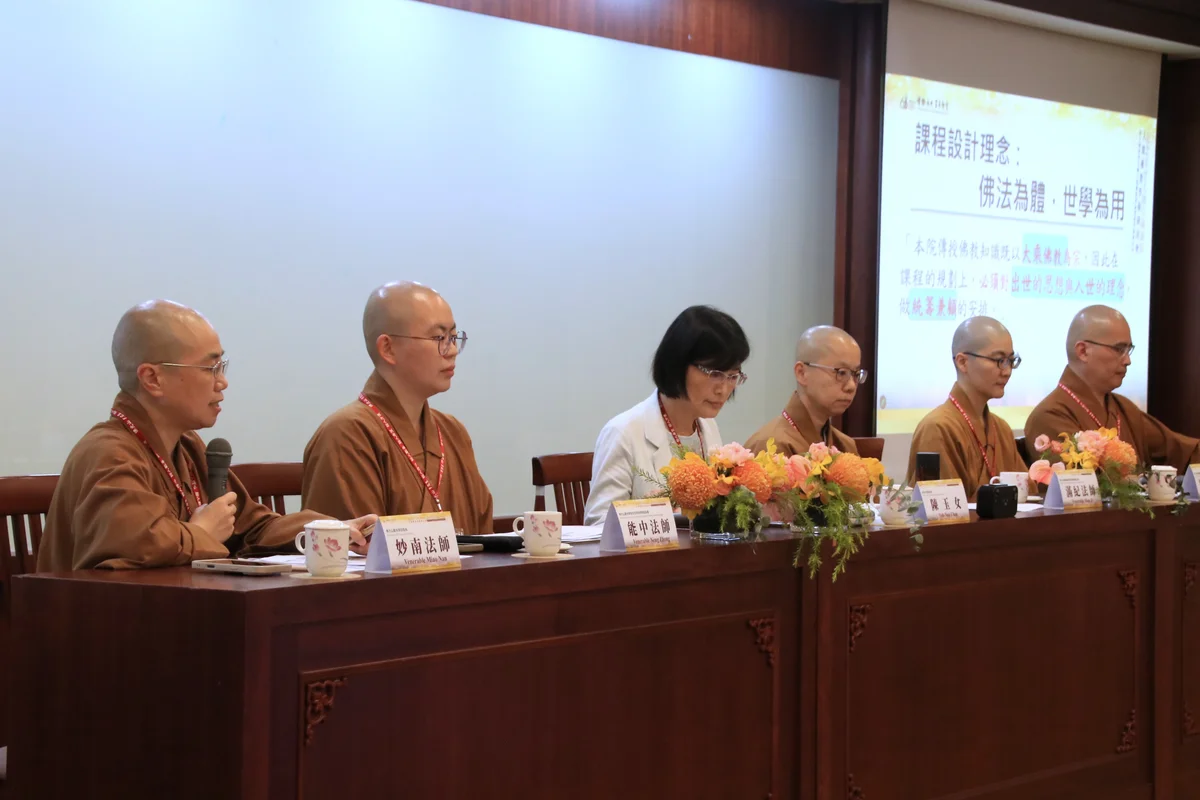
Panel 5, held on August 22 under the theme “Research on Monastic Education in Fo Guang Shan,” was chaired by Dr. Yuh-Neu Chen, Vice President of National Cheng Kung University. Presentations were delivered by Venerable Man Ji, Editor-in-Chief of the Fo Guang Buddhist Canon: Avatamsaka Canon at the Fo Guang Shan Buddhist Canon Committee; Venerable Zhi Qian, Editor of the Fo Guang Buddhist Canon: Avatamsaka Canon at the Fo Guang Shan Buddhist Canon Committee; the Fo Guang Shan Tsung Lin University Special Issue Editorial Team; Venerable Neng Zhong, Student Affairs Instructor at the Women’s Buddhist College of Fo Guang Shan Tsung Lin University; Venerable Miao Nan, Chancellor of Fo Guang Shan Tsung Lin University; and Venerable Hui Zhong, Lecturer at the Men’s Buddhist College of Fo Guang Shan Tsung Lin University. The six studies examined the educational spirit, philosophical foundations, institutional evolution, life education, curriculum design, and lifelong learning that have shaped six decades of Venerable Master Hsing Yun’s monastic education. Nearly 240 scholars and observers participated onsite and online.
Serving as the general coordinator of the monastic education research project, Venerable Man Ji presented “Six Decades of Shoushan Spirit: An Introduction to Venerable Master Hsing Yun’s Sixty Years of Monastic Education.” She explained that the larger publication project consists of six chapters, with “selflessness” serving as the central thread connecting the entire work.
Venerable Man Ji described the “Shoushan Spirit” at the heart of the introductory chapter as the purity of purpose behind education: teaching solely to transmit the Dharma, impart knowledge, resolve questions, and cultivate Buddhist talent. Within this approach, learning becomes an inner aspiration rather than an external requirement, while teaching carries a sense of sacred responsibility and reverence. Mutual respect between teachers and students, she noted, helped create an independent and highly effective learning community.
Venerable Zhi Qian presented “The Foundations of Venerable Master Hsing Yun’s Educational Philosophy: An Approach through His Personality.” Examining the Master’s character and philosophy of life, she traced the roots of his educational vision from his philosophy of “giving” to what she described as the philosophies of “not wanting” and “being second,” ultimately arriving at the principle of “selflessness.”
Venerable Zhi Qian explained that Venerable Master Hsing Yun’s lifelong dedication to Buddhism can be understood through compassion, joy, generosity, cherishing blessings, forming affinities, aspiration, and broad-mindedness. At their foundation, however, she argued, lies a selfless orientation that enabled him to devote himself fully to the cultivation of Buddhist talent and the development of Buddhist education.
The Fo Guang Shan Tsung Lin University Special Issue Editorial Team presented “The Evolution of Venerable Master Hsing Yun’s Monastic Education: A Historical Review Centered on the ‘Accomplishment of Place and Time’ among the Six Accomplishments.” The study traced institutional change through the two dimensions of time and place.
In terms of educational structure, the development began with Shoushan Buddhist College in 1965, followed by Fo Guang Shan Tsung Lin University and the Chinese Buddhist Research Institute. A three-tier educational system was established in 1989, together with international divisions and Buddhist programs in English and Japanese. In terms of physical space, monastic education developed from a single classroom at Shoushan Temple into the dedicated educational facilities gradually established after the founding of Fo Guang Shan.
Although educational systems and facilities evolved in response to changing circumstances, the study emphasized that the fundamental mission remained consistent: cultivating Dharma propagators through an education that integrates understanding and practice.
Venerable Neng Zhong presented “The Practice of Venerable Master Hsing Yun’s Life Education: An Exploration Centered on the ‘Three-Tiered Progressive Structure.’” She identified the core of life education as the principle of “five years of learning the precepts,” through which students cultivate proper conduct in walking, standing, sitting, and lying down, learn patience through everyday duties, develop compassion, and ultimately move toward self-awareness.
Venerable Neng Zhong outlined a three-tiered progression from basic education to character education and finally to education in self-awareness. She further described a framework in which regulating the six sense faculties forms the “substance,” patience and gentleness the “form,” and learning how to conduct oneself and accomplish tasks the “function.”
The educational process begins with willingness and dedication. For teachers, she added, an essential principle of guidance is to “live within the lives of the students,” allowing education to take place through shared daily experience rather than instruction alone.
Venerable Miao Nan presented “The Development of Venerable Master Hsing Yun’s Education: Curriculum Design and the Credit System Centered on the Principle of ‘Buddhist Dharma as the Substance, Secular Learning as Its Application.’” She identified the guiding spirit of intellectual education as “Buddhism first, oneself second,” supported by the Four Unshakable Faiths.
The curriculum was structured around the principle of “Buddhist Dharma as the substance, secular learning as its application.” From the three educational guidelines of Shoushan Buddhist College in 1965 to the establishment in 1975 of five colleges devoted to doctrine, practice, propagation, arts, and languages, Venerable Master Hsing Yun gradually developed a comprehensive educational framework.
Venerable Miao Nan also noted that a credit system was introduced as early as 1965. More than half of students’ overall time, however, consisted of zero-credit extracurricular activities, highlighting an educational philosophy in which understanding and practice, classroom learning and daily cultivation, were equally important.
Venerable Hui Zhong presented “The Construction of Venerable Master Hsing Yun’s Lifelong Education: A Textual Analysis Centered on ‘A Letter from a Dharma Teacher at the Light Transmission Academy.’” He explained that in Venerable Master Hsing Yun’s vision, the monastery itself functioned as a school and monastic education continued throughout one’s life.
Venerable Hui Zhong distinguished between the “forest-dwelling bhikṣu” cultivated during the Buddhist college stage and the “Humanistic bhikṣu” engaged in actual Dharma propagation. His chapter focused on the latter. Through an analysis of letters personally written by Venerable Master Hsing Yun as teaching materials, he showed that earlier instruction emphasized both academic study and spiritual cultivation, while later guidance placed increasing emphasis on spiritual development and the integrity of monastic character.
In her concluding remarks, Venerable Man Ji observed that although the six chapters approach monastic education from different perspectives, together they reveal an educational vision centered on “selflessness.” From the Shoushan Spirit and institutional development to life education, curriculum design, and lifelong learning, the studies demonstrate how this principle has informed both the ideals and practical structures of Fo Guang Shan’s monastic education.
Dr. Yuh-Neu Chen also commended the project for using “selflessness” as a unifying thread. She suggested that future research could further examine the organizational functioning of the Sangha, the sources and development of teaching personnel, and the difficulties encountered in establishing and sustaining monastic education, as well as the ways those challenges were overcome. Such additions, she noted, would provide an even fuller account of the development of Fo Guang Shan’s monastic educational system.
評論(0)
目前沒有評論,歡迎分享您的看法。
登入會員後即可發表評論、回覆及讚。